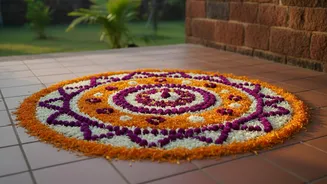








Prioritise Local and Native Flowers
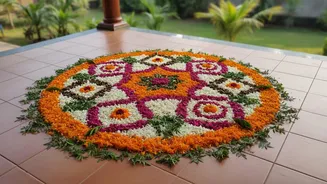
The beauty of a pookkalam lies in its connection to the local landscape. Traditionally, flowers used were those that grew in abundance nearby. However, modern pookkalams sometimes rely on flowers transported from other states or even countries, which
carries a significant carbon footprint. This Onam, make a conscious choice to use locally sourced and native flowers like marigolds (jamanthi), jasmine (mulla), globe amaranth (vadamalli), and hibiscus (chembarathi). These are not only more authentic to the spirit of the harvest festival but also fresher and support local growers and economies. By choosing flowers that haven’t travelled hundreds of kilometres, you reduce waste and celebrate the true flora of the season.
Explore Your Own Backyard
The most sustainable flowers are the ones you don't have to buy at all. Many homes and gardens in India are treasure troves of potential pookkalam materials. Before heading to the market, take a walk around your own garden or neighbourhood. Apart from flowers, colourful leaves, the vibrant green of tulsi, and other foliage can add texture and natural beauty to your design. This practice not only saves money but also reconnects the family with the nature in its immediate surroundings, turning the gathering of materials into a meaningful activity in itself. It’s a wonderful way to teach children about local plants and the joy of creating with what nature provides right at your doorstep.
Look Beyond Petals
While flowers are the main event, a truly sustainable pookkalam can incorporate a variety of natural materials. Think creatively about what you can use to add colour and texture. Coloured rice, different types of pulses and lentils, sawdust, and even spices from your kitchen can create stunning and eco-friendly fillers. Fallen leaves, small twigs, and seeds can also be used to create earthy and organic patterns within your design. These materials are completely biodegradable and offer a unique aesthetic that sets your pookkalam apart, proving that beauty doesn’t always have to come from a flower petal.
Avoid Synthetic Colours and Glitter
In the pursuit of brighter colours, many people turn to synthetic powders and plastic glitter. These materials are significant pollutants. They are non-biodegradable and can contaminate soil and water when the pookkalam is cleared away. Instead, embrace natural alternatives. Turmeric powder provides a brilliant yellow, while kumkum offers a deep red. You can create other colours by grinding dried flowers or leaves. For instance, dried and powdered hibiscus can create a reddish-purple hue, while dried spinach or other green leaves can be powdered for a natural green. This approach keeps your pookkalam completely organic and safe for the environment.
Rethink the Base and Structure
The base of many modern floral arrangements often involves floral foam, a non-biodegradable, petroleum-based plastic that is harmful to the environment. Traditionally, pookkalams were made directly on a floor cleansed with cow dung, or on a bed of mud. For a modern, indoor-friendly approach, you can create your design on a reusable mat, a large steel or brass plate (thaalam), or even a base of woven coconut leaves. If you need a structure to hold stems, consider using reusable metal grids, chicken wire, or even a foundation of natural moss instead of foam. These alternatives provide stability without the environmental cost.
Plan for Responsible Disposal
The life of a pookkalam is short, but its end-of-life impact doesn’t have to be negative. Once the festivities are over, the disposal of the flowers is a crucial step in ensuring sustainability. If your pookkalam is made entirely of natural materials, the entire arrangement can be composted. Floral waste is rich in nitrogen and makes for excellent compost, returning nutrients back to the earth. You can set up a small composting pot or pit in your garden or a community space. This final act closes the loop, transforming your beautiful creation into something that will nourish the soil, perfectly embodying the harvest festival's theme of nature’s cyclical abundance.