
A Cosmic Sugar Rush
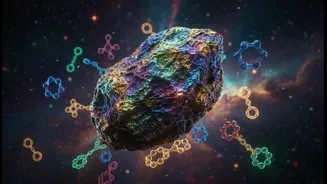
Scientists have confirmed the presence of bio-essential sugars, most notably ribose, in carbon-rich meteorites that have fallen to Earth. An international team analyzing fragments of meteorites like the Murchison and NWA 801 found the first direct evidence
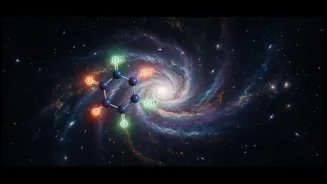
of ribose in space. Ribose is a critical component of RNA (ribonucleic acid), a molecule that was likely a forerunner to DNA in early life. Previously, researchers had found other building blocks of life like amino acids and nucleobases in meteorites, but sugars were the missing piece of the puzzle. This discovery was bolstered by subsequent finds, including a recent July 2026 detection of another complex sugar, erythrulose, in a vast gas cloud near the center of the Milky Way.
The Building Block of Biology
So, why is finding sugar in a space rock so exciting? Ribose is not just any sugar; on Earth, it forms the structural backbone of RNA. In modern life, RNA acts as a messenger, carrying out the genetic instructions encoded in DNA to build proteins. However, many scientists subscribe to the "RNA World" hypothesis, which posits that RNA came before DNA and was once capable of both storing genetic information and catalyzing chemical reactions—essentially running the whole show for primitive life. The presence of extraterrestrial ribose suggests that a key ingredient for this early form of life wasn't just available on prebiotic Earth, but could have been delivered from space.
Special Delivery from the Cosmos
The discovery supports a long-standing hypothesis that the raw materials for life on Earth were delivered via impacts from asteroids and comets billions of years ago. The early Earth was a chaotic place, and while it had some of the right conditions, it may have needed a helping hand to get the complex chemistry of life started. These meteorites act as "frozen time capsules," preserving the chemical makeup of the early solar system. By finding ribose and other sugars within them, scientists can infer that these molecules are formed through natural chemical reactions on asteroids, the parent bodies of these meteorites. This means the universe is capable of making life's ingredients far from the confines of a planet.
What This Doesn't Mean
It's crucial to understand that finding sugar in space is not evidence of alien life. Scientists did not find extraterrestrial organisms or even cells. What they found are prebiotic molecules—the non-living chemical components that life requires. To ensure their findings were genuinely extraterrestrial, researchers conducted isotopic analysis. Life on Earth shows a preference for a lighter type of carbon atom (Carbon-12). The carbon in the meteorite sugars was significantly enriched with a heavier version (Carbon-13), confirming it originated in space and wasn't just contamination from Earth. The discovery isn't about finding life, but about finding that the potential for life's chemistry is widespread.
The Future of the Search
This breakthrough provides a new focus for astrobiology research. The fact that a fragile molecule like ribose can survive in ancient meteorites is remarkable to scientists. It gives them confidence that ongoing and future missions to sample asteroids, like NASA's OSIRIS-REx mission which returned samples from the asteroid Bennu, will yield even more clues. In fact, analysis of the Bennu samples has already confirmed the presence of ribose and even glucose. By studying the abundance and variety of these extraterrestrial molecules, researchers can refine their models of how life might begin, not just on Earth, but on countless other worlds across the galaxy. The search continues, now with a much sweeter outlook.