





The Thin Red Air Problem
Stepping onto Mars without a suit would be instantly fatal, and not just because of the cold. The Martian atmosphere is over 95% carbon dioxide, with a pressure less than 1% of Earth's. For humans to survive, let alone establish a long-term presence,
we need a reliable source of breathable oxygen. For decades, the only solution was to bring it all with us—an incredibly heavy and expensive proposition for a mission that could last for years. A round trip to Mars requires tonnes of supplies, and every kilogram launched from Earth adds immense cost and complexity. This is where the concept of 'in-situ resource utilization', or ISRU, becomes a game-changer: using what's already there to create what you need.
A Toaster-Sized Tree on Mars
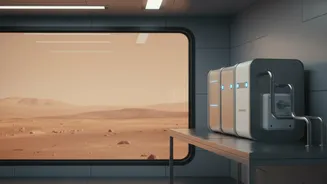
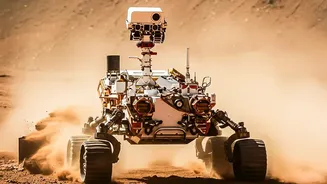
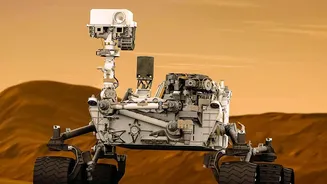
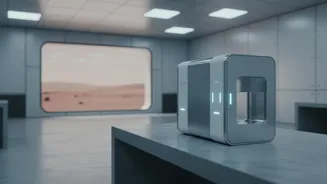
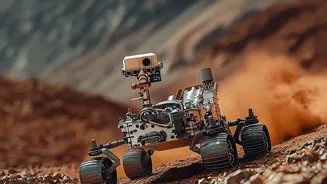
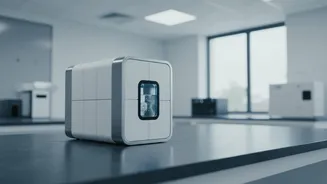
The first major proof that we could 'live off the land' on Mars came from a small, golden box inside the Perseverance rover. Called MOXIE, for Mars Oxygen In-Situ Resource Utilization Experiment, this toaster-sized device was designed to do one incredible thing: inhale Martian carbon dioxide and exhale pure oxygen. It worked using a process called solid oxide electrolysis. The system pulled in the thin Martian air, compressed it, and then heated it to around 800 degrees Celsius. At this extreme temperature, an electrochemical process splits the carbon dioxide (CO2) molecules, separating one oxygen atom and leaving carbon monoxide (CO) as a byproduct. Between 2021 and 2023, MOXIE ran 16 times, successfully producing high-purity oxygen under different seasonal and daily conditions. It proved, for the first time, that we can make a breathable atmosphere from the raw materials of another planet.
From Proof to Production Plant
While MOXIE was a historic success, it was always just a demonstration. In its entire operational life, it produced 122 grams of oxygen—enough to keep a small dog alive for about 10 hours. To support human explorers, we need to scale up dramatically. This is where the 'upgraded' systems come in. Scientists and engineers are now designing the next generation of oxygen generators. These future systems would be several hundred times more powerful than MOXIE, capable of producing kilograms of oxygen per hour, not just a few grams. The upgrade isn't just about size; it's about endurance and automation. A full-scale plant would need to run continuously for months on end, likely before astronauts even arrive, to produce and stockpile the necessary oxygen. This requires improvements in durability, efficiency, and the ability to operate autonomously in the harsh Martian environment.
More Than Just for Breathing
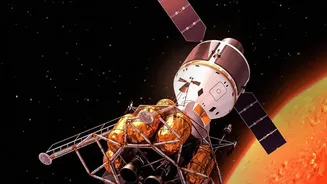
While breathable air is the most obvious benefit, it's surprisingly not the biggest reason for making oxygen on Mars. The single largest consumer of oxygen on a crewed mission will be the rocket needed to get astronauts off the planet for their journey home. Rocket propellant consists of fuel and an oxidizer—and liquid oxygen is an excellent oxidizer. To launch a Mars Ascent Vehicle back into orbit, current estimates suggest it would need around 25 tonnes of liquid oxygen. Carrying all that from Earth is practically a non-starter. Producing it on Mars transforms the entire mission architecture, drastically reducing the mass that needs to be launched from Earth and making a return trip feasible. The oxygen can also be used for other purposes, such as in life support systems or for ground vehicles.
The Path to a Martian Outpost
The success of MOXIE has paved the way for these more ambitious, upgraded systems. The next major milestone won't just be a more powerful oxygen generator, but a complete system that can also liquefy the gas and store it. Researchers are also exploring complementary technologies, like using plasma to split CO2 molecules or developing AI-driven robotic chemists that could find and process water ice to extract oxygen. These technologies are critical building blocks for the future of human exploration. Each advance that allows us to use local resources makes establishing a sustained presence on the Moon and Mars more achievable and less dependent on an impossibly long supply chain from Earth. The air on Mars may be thin, but human ingenuity is proving it's full of potential.