



The Question of Age
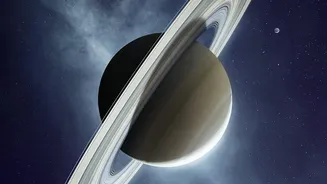
For a long time, astronomers assumed the rings were as old as Saturn itself, forming 4.5 billion years ago. However, data from NASA's Cassini mission, which orbited the planet from 2004 to 2017, turned this idea on its head. The rings are surprisingly
pristine and bright. They are made almost entirely of water ice, with very little contamination from rocky meteoroids. If they were ancient, they should have been darkened by billions of years of cosmic dust. This led to a new, dominant theory: the rings are young, perhaps only 100 to 400 million years old. This means they may have formed while dinosaurs roamed the Earth, possibly from a moon or a large comet that was torn apart by Saturn's gravity. However, the debate isn't settled, with some recent models suggesting the rings could indeed be ancient if there are mechanisms that keep them clean.
The Disappearing Act
Perhaps the most startling discovery is that the rings are disappearing. Scientists have confirmed the existence of "ring rain"—a phenomenon where icy particles from the rings are pulled in by Saturn's gravity and magnetic field, falling into the planet's upper atmosphere. Data from Cassini's final orbits revealed this isn't a gentle drizzle; it's a downpour, dumping tonnes of water onto the planet every second. This process is actively draining the rings of their material. Based on the current rate of loss, some estimates predict the entire ring system could be gone in as little as 100 million years, and will likely be gone within 300 million years. Understanding the exact rate of this decay is a top priority, as it holds the key to confirming the rings' true age and ultimate fate.
Mysterious Spokes and Structures
The puzzles don't stop there. The rings exhibit strange, temporary features that defy easy explanation. Among the most curious are the "spokes," which are transient, dark, or bright radial markings that appear across the B ring. First spotted by the Voyager spacecraft in the 1980s, these features can be larger than the diameter of Earth and appear to be a seasonal phenomenon, becoming more frequent as Saturn approaches its equinox. The leading theory is that they are caused by tiny, electrostatically charged ice particles levitating above the main ring plane, possibly due to interactions with the planet's magnetic field and solar wind. Yet, the precise mechanism that creates them remains an active mystery that scientists are still working to solve.
A surprisingly Dynamic System
Rather than a simple disc of particles, the rings are a chaotic and lively environment. The Cassini mission revealed an intricate structure of thousands of gaps and ringlets, many of which are shaped by the gravitational pull of Saturn's small inner moons. Some of these moons, like Pan and Daphnis, are essentially ring-particle collectors, with loose material accreting around their equators, giving them a distinctive "ravioli" shape. Other moons, like the geyser-spewing Enceladus, are actually feeding the rings, supplying ice and dust to the faint E-ring. This constant exchange of material between moons and rings shows a system that is far more interactive and complex than was ever imagined.