


A Journey of 25.9 Billion Kilometres
Imagine sending a message and having to wait a full day for it to arrive. Now imagine waiting another full day for the reply. This 48-hour round trip will become the new reality for engineers communicating with Voyager 1 on November 18. On this date,
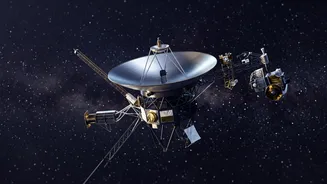
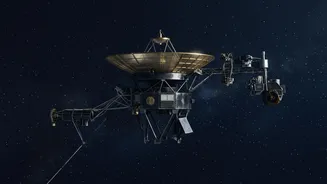
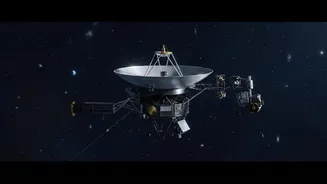
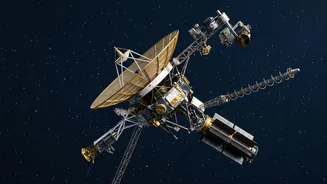
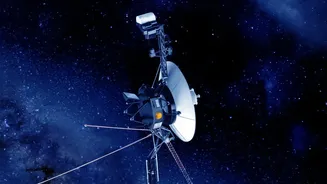
the intrepid probe will be one light-day from Earth, a distance of approximately 25.9 billion kilometres. A light-day is the distance light travels in 24 hours. While light from the Sun takes just over eight minutes to reach us, the signal from Voyager 1 will require an entire day. This milestone isn't a physical boundary, but a profound marker of the immense gulf separating this human-made object from its home. It has taken the spacecraft, travelling at over 61,000 kilometres per hour, more than 49 years to cover this distance since its launch.
Humanity's Loneliest Traveller
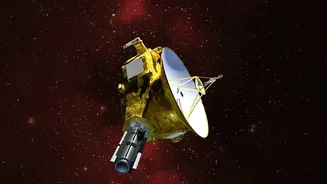
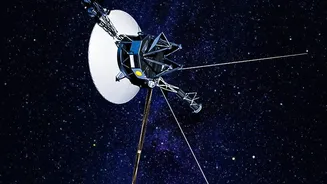
Launched on September 5, 1977, Voyager 1 and its twin, Voyager 2, were initially designed for a five-year mission to study Jupiter and Saturn. Voyager 1 provided unprecedented views of the gas giants and their moons, discovering volcanic activity on Io and the complexity of Saturn's rings. After its planetary encounters, its trajectory sent it hurtling towards the edge of our solar system. In August 2012, it made history by crossing the heliopause—the boundary where the Sun's magnetic field and solar wind cease—becoming the first spacecraft to enter interstellar space. It is now humanity’s sole active probe in the vast, empty region between the stars, a testament to the enduring power of 1970s engineering.
A Whisper Across the Void
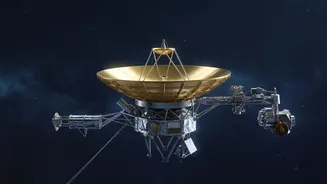
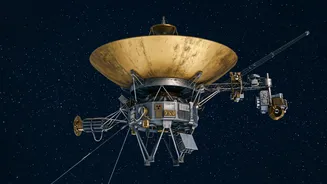
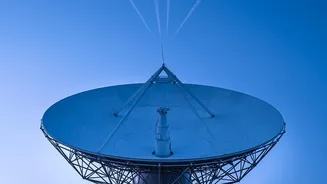
Communicating with Voyager 1 is a monumental challenge. Its 23-watt transmitter has about the same power as a refrigerator light bulb. By the time its faint signal reaches Earth, it is billions of times weaker. It can only be detected by the massive, highly sensitive antennas of NASA's Deep Space Network (DSN), a global array of radio dishes in the United States, Spain, and Australia. These stations are essential for tracking the probe and receiving the precious data it continues to collect. Keeping this connection alive has become an increasing struggle. The probe's power, supplied by decaying plutonium in its Radioisotope Thermoelectric Generators (RTGs), decreases by about four watts each year. Engineers have had to make difficult decisions, shutting down instruments and heaters to conserve every possible watt. Despite these efforts and recent communication glitches, the mission persists.
What Is Voyager 1 Seeing Now?
Having left our solar system's protective bubble, Voyager 1 is now providing direct measurements of interstellar space. While many of its original ten instruments have been powered down to save energy, two remain active: the Magnetometer (MAG) and the Plasma Wave Subsystem (PWS). These instruments measure the magnetic fields and plasma waves of the interstellar medium, providing invaluable data about the environment outside our solar system. The probe is currently heading in the direction of the constellation Ophiuchus. Though its journey seems swift, space is vast. In about 40,000 years, it will pass near a star named Gliese 445, but by then its power will have long since faded.
A Message in a Bottle
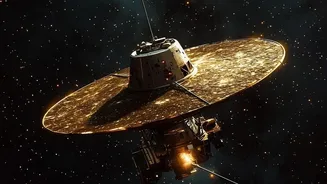
Beyond its scientific mission, Voyager 1 carries a cultural artefact of profound significance: the Golden Record. This gold-plated copper disk is a time capsule, containing sounds and images selected to portray the diversity of life and culture on Earth. Curated by a committee led by astronomer Carl Sagan, it includes greetings in 55 languages, music from around the world, and 115 images of life on our planet. It is a message in a bottle cast into the cosmic ocean, a greeting intended for any intelligent extraterrestrial life that might one day encounter the silent spacecraft. It represents a hope and a story that will long outlive the probe’s ability to phone home.