


A Precise Landing, A Giant Leap
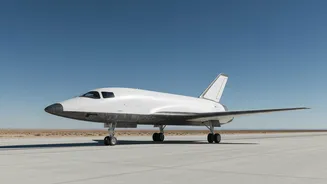
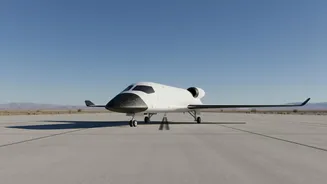
ISRO has successfully completed a series of complex landing experiments, known as the RLV-LEX, at the Aeronautical Test Range in Chitradurga, Karnataka. In the most recent test, the winged vehicle, named 'Pushpak', was carried to an altitude of 4.5 km
by an Indian Air Force Chinook helicopter and released. From there, Pushpak flew on its own, performing tricky manoeuvres to correct its path before executing a perfect, high-speed horizontal landing on the runway. This test simulated the incredibly difficult final phase of a space mission, proving that ISRO has mastered the technology needed for a vehicle to return from space and land with pinpoint accuracy, completely autonomously.
The High Stakes of a Soft Landing
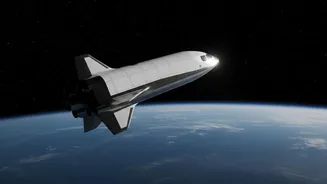
Landing a vehicle returning from space is one of the greatest challenges in aerospace engineering. The craft endures extreme temperatures and travels at hypersonic speeds, far faster than any commercial jet. For the landing to succeed, the vehicle's onboard computers must make split-second decisions without any human help, managing everything from navigation and guidance to deploying a brake parachute and applying brakes to slow down from over 320 kmph to a halt. The success of the Pushpak landing experiments, which reused the same winged body across multiple tests, demonstrates the robustness of ISRO’s design and its mastery over the complex control systems required for autonomous re-entry and landing.
The Billion-Dollar Question: Why Reusability?
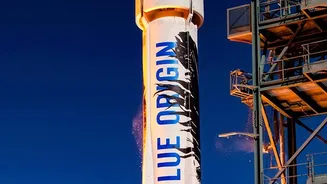
The primary driver behind developing reusable launch vehicles is economics. Traditionally, rockets are single-use; their most expensive components, the boosters and engines, are discarded after every launch. This is like throwing away an entire airplane after just one flight. Reusable systems, like those pioneered by SpaceX, allow the most valuable parts of the rocket to return to Earth, be refurbished, and fly again. This drastically cuts the cost of each launch. By developing its own reusable technology, ISRO is positioning India to compete in the multi-billion dollar global satellite launch market, offering a much more affordable alternative and aiming to bring down launch costs significantly.
India's 'Pushpak' in a Global Context
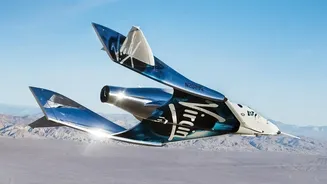
While SpaceX has famously mastered vertical landings with its Falcon 9 boosters, ISRO's Pushpak is a winged vehicle, more akin to an autonomous space plane. This approach is part of ISRO's long-term vision for a Two-Stage-to-Orbit (TSTO) launch vehicle, where the reusable winged first stage would fly back and land on a runway after deploying the upper stage, which then carries the satellite to orbit. This is a technologically challenging but potentially very efficient method for achieving reusability. The recent landing experiments are a crucial validation of this approach, proving the vehicle can handle the critical landing phase.
The Road Ahead to Orbit
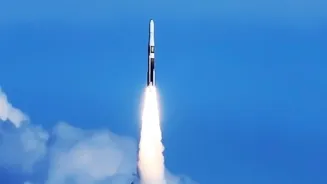
It's important to note that the recent successes were landing experiments, not full orbital flights. Pushpak was lifted to altitude, not launched into space on a rocket. These tests are designed to perfect the final, and riskiest, part of the mission first. The next major step will be an orbital re-entry experiment, where a larger version of Pushpak will be launched into orbit on a rocket and then return to Earth, enduring the full heat and stress of re-entry before attempting an autonomous landing. While an operational reusable launcher is still some years away, these successful tests show that ISRO is on a clear and determined path to achieving its goal.