







The Age-Old Foundation Problem
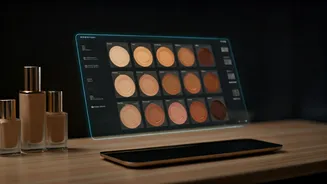
For decades, buying foundation has been a high-stakes gamble. Shoppers have had to rely on flawed methods, from dabbing testers on their hands under harsh store lighting to guessing their shade from online charts that look different on every screen. This
trial-and-error process is not only frustrating for consumers but also costly for brands, with shade mismatches being a primary driver of product returns. The process is complicated by the nuances of skin, including not just the primary tone but also the subtle warm, cool, or neutral undertones that determine a truly seamless match.
How AI Enters the Picture
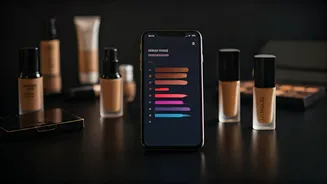
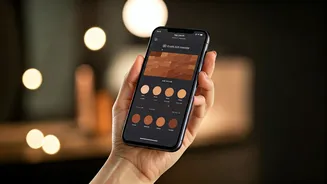
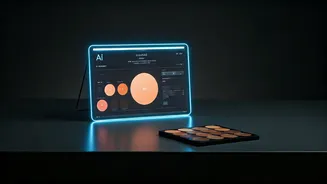
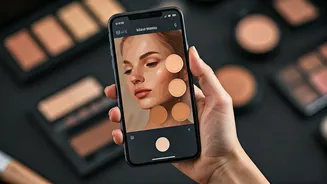
Artificial intelligence is tackling this problem by replacing subjective guesswork with data-driven analysis. Modern AI shade finders use your phone's camera to perform a sophisticated scan of your face. Advanced algorithms then analyze hundreds of points on your skin, detecting your precise tone and, crucially, your undertones. Using computer vision and deep learning, the tool compares your unique skin data against a massive database of foundation products to recommend the best match. Some platforms are even trained on databases of up to 90,000 unique skin tones, ensuring a high degree of precision.
The Brands Leading the Charge
This isn't a niche technology; major players in the beauty industry have embraced AI to enhance the customer experience. Brands like Estée Lauder, L'Oréal, Fenty Beauty, and Mary Kay have all rolled out AI-powered tools on their websites and apps. Tech companies like Perfect Corp and Arbelle are partnering with a wide range of brands to integrate this technology, making it an increasingly standard part of the online shopping journey. These tools often combine the shade recommendation with an augmented reality (AR) virtual try-on, allowing you to see how the foundation will look on your own face in real-time.
Is It Really a Perfect Match?
While AI offers a significant leap forward, it isn't foolproof. The single biggest variable affecting accuracy is lighting. A scan taken in warm, artificial indoor light can produce a different result than one taken in natural daylight. Likewise, the quality of your smartphone's camera can influence the outcome. There are also concerns about algorithmic bias and ensuring the technology works equally well across the full spectrum of skin tones, a challenge many developers are actively working to solve by using more inclusive datasets like the Monk Skin Tone Scale. Despite these challenges, when conditions are right, AI has been shown to be significantly more accurate than traditional methods.
Tips for Getting the Best Results
To get the most out of an AI shade finder, you can take a few simple steps to improve accuracy. First and foremost, always take your photo in natural daylight, as this provides the most true-to-life color information. Face a window and ensure your face is evenly lit, without strong shadows. Make sure your skin is clean and free of any makeup. Hold your phone at arm's length and capture your face directly, as angles can distort both lighting and your features. Some tools even use a physical color card held next to your face to help the AI calibrate the lighting and color for an even more precise reading.