



The Invisible Scaffolding
One of the biggest puzzles in astrophysics is that most of the universe seems to be missing. The gravitational pull we observe in and between galaxies is far stronger than what their visible stars, gas, and dust can account for. The solution, scientists
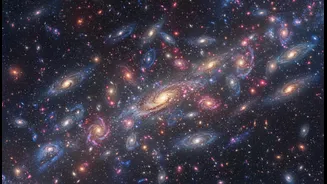
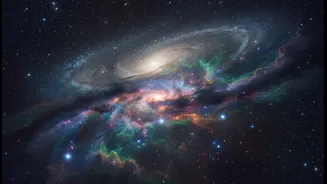
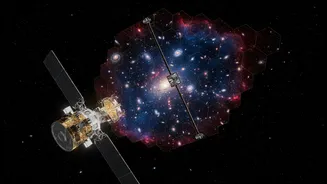
believe, is dark matter, an invisible substance that makes up about 85% of all matter. While we cannot see it, we can see its effects on galaxy growth. Current models show that after the Big Bang, dark matter began clumping together, forming massive, invisible halos. These halos acted as a cosmic scaffolding, creating deep gravitational wells that pulled in ordinary matter like hydrogen and helium. Without this dark matter framework, the gas would have been too diffuse to collapse and form the first stars and galaxies. In essence, by observing where and how galaxies form, astronomers are mapping the unseen architecture of the universe, turning galaxies into luminous tracers for the dark matter that dominates the cosmos.
Peeking into the Cosmic Dawn
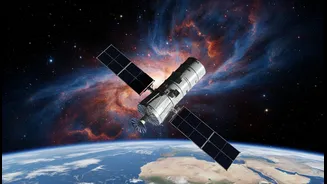
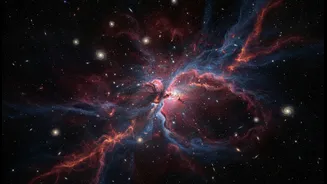
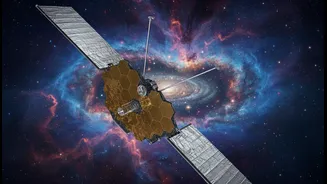
For a long time, the earliest chapter of the universe's history was hidden from us, a period sometimes called the “Cosmic Dark Ages.” But with powerful new instruments like the James Webb Space Telescope (JWST), astronomers are now punching through the veil. JWST is designed to capture the faint, infrared light from the universe's first galaxies, light that has been stretched over billions of years as the universe expanded. These observations are revealing a startlingly busy infant universe. Scientists have spotted galaxies that existed just a few hundred million years after the Big Bang, much earlier than once thought possible. These primordial galaxies look different from the stately spirals we see today; they are often smaller, clumpy, and irregular, blazing with intense bursts of star formation. By studying their chemical makeup and structure, scientists can reconstruct the process of how the first stars ignited, seeded the universe with heavier elements, and began clearing the cosmic fog of neutral hydrogen that once filled space.
A Tale of Cosmic Mergers
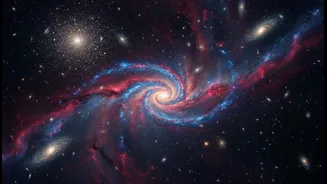
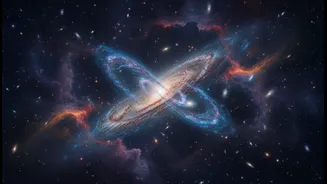
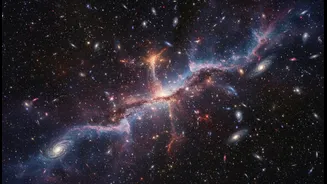
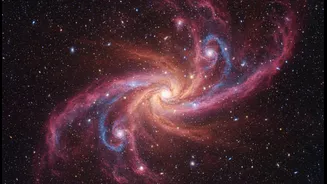
Galaxies do not grow in isolation. Their evolution is a dramatic story of interaction, collision, and cannibalism. Across cosmic history, gravity has pulled galaxies toward each other. When they get close, their gravitational forces can distort their shapes, pulling out long streamers of stars and gas. Often, this process ends in a full-blown merger, where two or more galaxies combine to form a single, larger one. These mergers were incredibly common in the early, more crowded universe and are a primary engine of galaxy growth. The collision can compress vast clouds of gas, triggering furious bursts of star formation. It is now widely believed that many of the large, elliptical galaxies we see today are the products of ancient mergers between spiral galaxies. Our own Milky Way is on a collision course with the Andromeda galaxy, set to merge in about 4.5 billion years. By studying these mergers at different distances, astronomers can understand how the cosmic web—the large-scale structure of the universe—was assembled over time.
Measuring an Expanding Universe
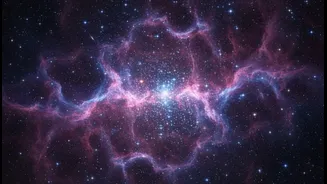
Galaxies also serve as the universe's ultimate yardsticks. In the 1920s, Edwin Hubble observed that nearly all galaxies are moving away from us, and the farther away a galaxy is, the faster it is receding. This was the first concrete evidence that the universe is expanding. Astronomers measure this recession by analyzing a galaxy's light; as it moves away, its light is stretched to longer, redder wavelengths in a phenomenon called redshift. The amount of redshift indicates its distance and speed. By using certain types of supernovae within distant galaxies as “standard candles”—explosions with a known intrinsic brightness—scientists can precisely measure distances across billions of light-years. In the late 1990s, this technique led to a shocking discovery: not only is the universe expanding, but its expansion is accelerating. This mysterious acceleration is attributed to dark energy, a force that acts as a sort of cosmic anti-gravity. The study of galaxies, therefore, not only revealed the Big Bang but also unveiled the existence of the dominant force shaping our universe's ultimate destiny.