
India’s Eye on the Sun
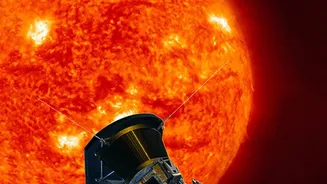
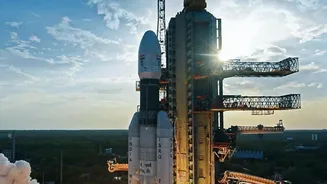
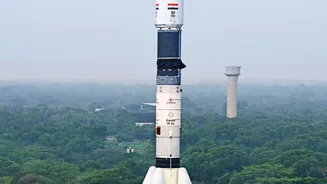
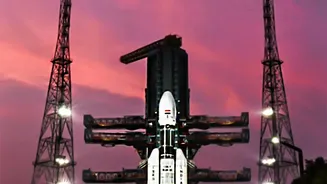
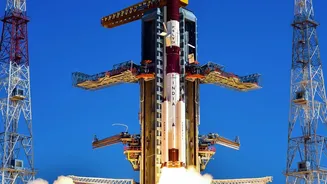
Since its celebrated launch on September 2, 2023, ISRO's Aditya-L1 has become a cornerstone of solar research. After a four-month journey, it settled into a halo orbit at Lagrange point 1 (L1) in January 2024. This special spot gives it an uninterrupted,
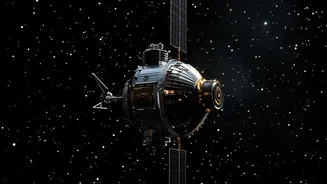
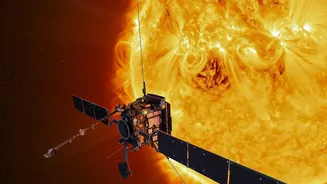
24/7 view of the Sun, free from any eclipses or occultations by Earth. The spacecraft is armed with seven sophisticated payloads designed to observe everything from the Sun's visible surface (photosphere) to its scorching outer atmosphere (corona). Four of these instruments perform remote sensing, essentially acting as powerful telescopes, while the other three conduct 'in-situ' studies, directly sampling the particles and magnetic fields that flow past the spacecraft. This dual capability makes Aditya-L1 a formidable tool for understanding solar dynamics and their effect on space weather.
Decoding the Solar Wind
One of the key puzzles Aditya-L1 was built to solve involves the solar wind—a relentless stream of charged particles flowing from the Sun. Recent findings from the Aditya Solar wind Particle Experiment (ASPEX) payload have been particularly revealing. The Solar Wind Ion Spectrometer (SWIS) instrument has been successfully measuring the speed, density, and direction of solar wind ions, primarily protons and alpha particles. These direct measurements are crucial. For instance, during major geomagnetic storms in 2024, data from Aditya-L1 helped scientists understand why unusual magnetic disturbances were recorded at dawn on Earth. The cause was traced back to a sudden drop in solar wind pressure, a connection that could only be confirmed by having a sentinel like Aditya-L1 in place. Scientists have also noted that a change in the ratio of alpha particles to protons can act as a crucial early warning for the arrival of Coronal Mass Ejections (CMEs), which are massive eruptions of solar plasma that can wreak havoc on technology.
New Clues in Cosmic Magnetism
The Sun's influence extends far beyond light and heat; it's driven by immense and complex magnetic fields. Aditya-L1's onboard magnetometer is providing vital data on the interplanetary magnetic field. Recent studies combining Aditya-L1 data with ground-based observations have offered new insights into how Earth's magnetic shield, the magnetosphere, responds to solar onslaughts. One study investigated a powerful solar storm from October 2024 and found that a turbulent region within the storm severely compressed Earth's magnetic field. This pushed the shield so close to the planet that some geostationary satellites were temporarily exposed to the harsh solar wind. Furthermore, scientists have used Aditya-L1's instruments to identify a fascinating precursor to major solar flares: small, short-lived bright spots in active magnetic regions that appear hours before a large eruption. This suggests that repeated, small-scale energy releases gradually destabilise a region's magnetic field, eventually triggering a major event.
Why These Findings Are a Game-Changer
The data streaming back from Aditya-L1 is more than just academic. Understanding the velocity and pressure of the solar wind, and how magnetic fields trigger solar flares, is the bedrock of space weather forecasting. Severe space weather can disrupt satellite communications, damage power grids, and pose a risk to astronauts. By identifying early warning signs of solar flares and better understanding how CMEs propagate, Aditya-L1 is providing the critical information needed to protect our technological infrastructure. For example, knowing that a CME is approaching allows satellite operators to put their spacecraft into a safe mode, and power grid managers can take precautions. These findings from India's first solar observatory are a significant step towards developing a reliable space weather prediction capability, safeguarding our modern way of life.