





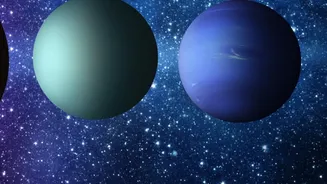
A New Class of World
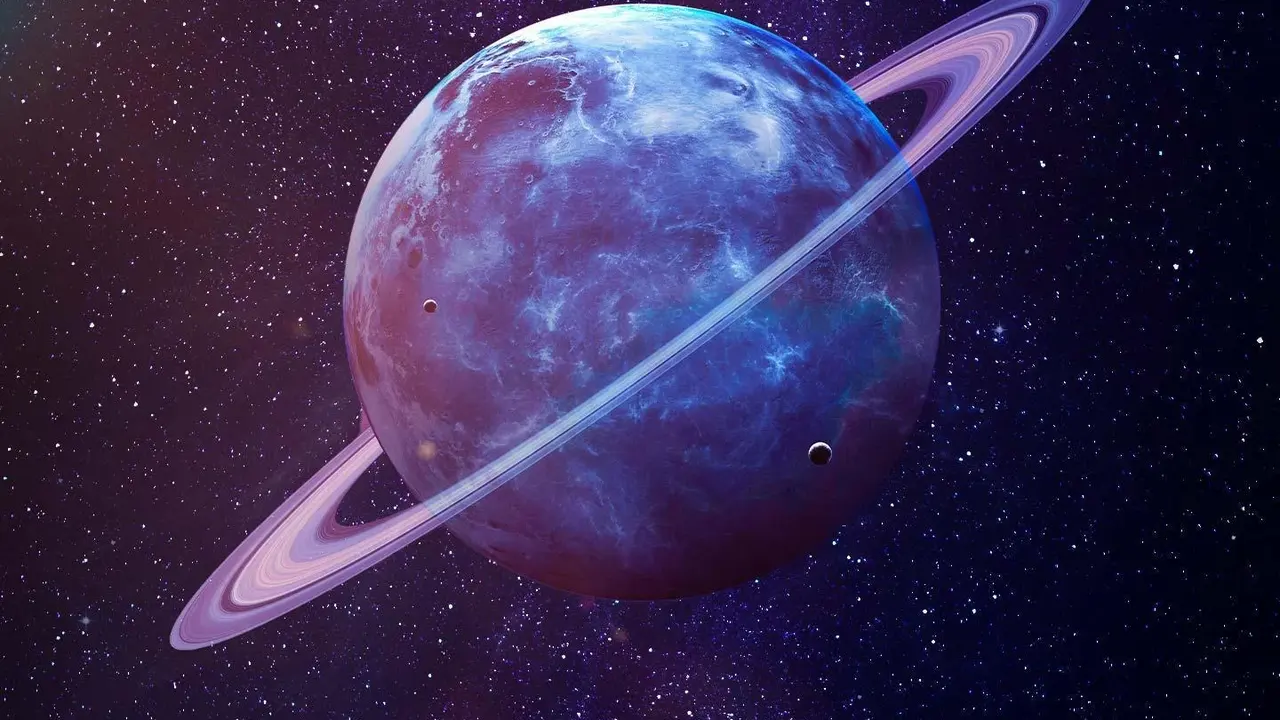
For decades, scientists hunting for habitable planets focused on rocky worlds like our own. But the most common type of planet discovered so far is the “sub-Neptune”—worlds larger than Earth but smaller than Neptune, with no direct solar system counterpart.
One of the most intriguing is K2-18 b, an exoplanet 120 light-years away that is 8.6 times the mass of Earth. Observations from JWST have confirmed it has a hydrogen-rich atmosphere containing carbon-bearing molecules, including methane and carbon dioxide. This composition is consistent with a theoretical new class of planet called a “Hycean” world—a portmanteau of hydrogen and ocean. These hypothetical planets are thought to feature vast, deep liquid-water oceans under a thick hydrogen atmosphere, a combination that could potentially support aquatic life.
The Methane Puzzle
The detection of methane is significant because, on Earth, the vast majority of methane in the atmosphere is produced by living organisms. Its presence on K2-18 b, a planet within its star's habitable zone, naturally raises the thrilling possibility of a biosignature. Adding to the intrigue, early JWST observations also hinted at the presence of another compound, dimethyl sulfide (DMS). On Earth, DMS is produced exclusively by life, primarily marine phytoplankton. However, the scientific community remains deeply divided. Follow-up analyses by independent teams, including a NASA-led study, have found the evidence for DMS to be inconclusive or not statistically significant, cautioning against jumping to conclusions. This highlights the immense challenge of interpreting faint chemical signals from light-years away.
Redefining 'Habitable'
These findings are forcing a fundamental rethink of what constitutes a “habitable” planet. The classic definition centered on Earth-like worlds in a star's “Goldilocks zone,” where surface temperatures allow for liquid water. Hycean worlds expand this definition considerably. Their thick hydrogen atmospheres could allow them to maintain liquid water oceans over a much wider range of distances from their stars than a rocky planet could. But recent research also introduces new complications. A study published in July 2026 suggests that deep clouds of vaporized rock on sub-Neptunes could act as a thermal blanket, trapping heat and raising temperatures at the boundary between the atmosphere and interior to thousands of degrees. This could create magma oceans and render the surface too hot for liquid water, posing a major obstacle to habitability.
Biology or Geology?
The core of the debate is distinguishing between biological and geological sources of methane. While life is a prolific producer, methane can also be generated by abiotic processes like outgassing from a planet’s interior or serpentinizing reactions involving water and rock. Scientists propose that the key isn't just finding methane, but finding it in a specific context. For instance, an atmosphere rich in both methane and carbon dioxide, but with very little carbon monoxide, would suggest a massive and continuous source of methane is required to maintain that chemical imbalance—a flux more easily explained by a widespread biosphere than by known geological processes. The ongoing analysis of K2-18 b and other sub-Neptunes is a live rehearsal for these very challenges, testing how carefully scientists must weigh evidence and rule out all non-biological explanations before making any grand claims.