








A Fundamental Shift in Focus
The romantic image of space travel has always been one of outward expansion and discovery. But a new, more urgent reality has taken hold within the world's leading space agencies and private companies. As the impacts of climate change, deforestation,
and pollution become more severe, the unique vantage point of orbit has transformed from a scientific curiosity into an indispensable tool for planetary management. This isn't about abandoning deep-space exploration; it's about rebalancing priorities. Agencies like NASA, the European Space Agency (ESA), and our own ISRO are dedicating more resources than ever to Earth-observing missions. They recognise that understanding and protecting our home world is not just a terrestrial task but a crucial space-faring responsibility. The health of Earth is, quite literally, mission critical.
The Planet's Watchful Eyes
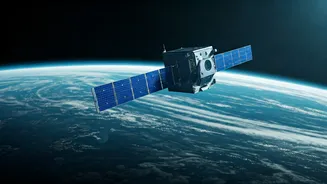
The most visible sign of this new priority is the fleet of advanced satellites tasked with monitoring Earth's vital signs. Think of them as a planetary-scale health check-up. The ESA's Copernicus programme, for example, provides a constant stream of data on everything from atmospheric chemistry and ocean currents to polar ice melt and land use changes. NASA's Landsat series has been doing this for 50 years, creating an unparalleled record of how our planet has changed. Here in India, ISRO’s Earth Observation Satellite (EOS) series is the backbone of our national development. These satellites provide critical data for weather forecasting, enabling accurate monsoon predictions that are vital for our agriculture. They also play a key role in disaster management, tracking cyclones and floods to help authorities evacuate vulnerable populations and coordinate relief efforts. They are, in essence, our eyes in the sky, providing the unbiased data needed to make life-saving decisions.
Cleaning Our Cosmic Backyard
The concern for Earth's environment now extends to the space immediately surrounding it. Decades of launches have left a halo of junk—defunct satellites, spent rocket stages, and fragments from collisions—orbiting the planet. This space debris poses a significant threat to active satellites, including those we rely on for communication, GPS, and climate monitoring. A single collision could create a cascade of new debris, potentially rendering certain orbits unusable. Recognizing this, space agencies are treating orbital space as an environment that needs protection. ISRO's Project NETRA (Network for Space Object Tracking and Analysis) is a prime example. It’s an early warning system to detect debris and prevent collisions. Globally, companies are developing innovative solutions, from robotic arms to giant nets, to actively remove the most dangerous pieces of junk. Keeping our orbit clean is no longer just a technical issue; it's an environmental imperative.
The Push for Greener Launches
The very act of getting to space has an environmental cost. Traditional rocket fuels release significant amounts of carbon dioxide and other pollutants into the atmosphere. As the pace of launches accelerates, especially with the rise of commercial players like SpaceX, the industry is confronting its own carbon footprint. The solution lies in two key areas: reusability and cleaner fuels. SpaceX's Falcon 9 rockets, with their reusable first-stage boosters, have dramatically reduced the waste and manufacturing energy associated with each launch. Meanwhile, researchers across the globe are exploring greener alternatives, including methane and hydrogen-based propellants, which produce fewer harmful emissions. The goal is to create a sustainable cycle of space access, ensuring that our journey to the stars doesn't come at the expense of the planet we leave behind. The era of 'disposable' rockets is slowly but surely coming to an end.