




The All-Important Atmosphere
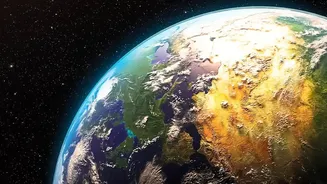
An orbit is just a location; an atmosphere is a planet's shield and climate control system. A planet needs a substantial atmosphere to protect its surface from harmful cosmic rays and stellar radiation. This gaseous envelope also traps heat, regulating
the planet's temperature and creating the pressure needed for liquid water to remain stable on the surface. Without it, a perfectly placed planet could be a barren, airless rock with its water either boiled away or frozen solid. Recently, astronomers found tantalizing evidence of the first atmosphere on a rocky planet in a habitable zone, a world called LHS 1140 b, highlighting how crucial and difficult this puzzle piece is to find.
A Planetary Force Field
Just as critical as an atmosphere is a planetary magnetic field. Generated by a planet's molten, rotating core, this invisible shield deflects the stellar wind—a constant stream of charged particles from the host star. Without a magnetic field, this solar wind can slowly strip a planet's atmosphere away over millions of years, a fate that scientists believe befell Mars. A strong magnetosphere is therefore considered a key requirement for long-term habitability, as it preserves both the atmosphere and any liquid water on the surface from being lost to space. It's a planet's primary defence against its own sun.
The Temperament of the Star
Not all stars are created equal. The type of star a planet orbits dramatically influences its potential for life. Many potentially habitable planets have been found orbiting red dwarfs, the most common type of star in our galaxy. These stars are cooler, so their habitable zones are much closer. This proximity, however, comes with dangers. Red dwarfs, especially when young, are prone to frequent and violent flares, blasting their nearby planets with high-energy radiation that can erode atmospheres and be hostile to life. Even older, more stable red dwarfs can unleash powerful flares. This makes the star's stability just as important as its brightness.
The Problem of Being Locked In
Planets orbiting close to their stars, particularly red dwarfs, are likely to become 'tidally locked'. This means one side of the planet permanently faces the star while the other is in perpetual darkness, creating extreme temperatures. One side could be scorchingly hot, while the other is frozen solid. For a long time, this was seen as a dealbreaker for habitability. However, recent climate models suggest that a thick enough atmosphere could potentially circulate heat from the day side to the night side, creating more moderate conditions in the 'terminator zone'—the twilight strip between night and day. But it remains a significant challenge to overcome.
The Right Planetary Ingredients
Finally, the planet itself must have the right stuff. This includes its mass, composition, and geology. A planet that is too small cannot hold onto its atmosphere, while one that is too large is more likely to be a gas giant like Jupiter. A rocky composition similar to Earth's is seen as a good starting point. Furthermore, geological activity, such as plate tectonics and volcanism, plays a vital role in regulating a planet's climate over billions of years. This activity cycles elements like carbon between the interior, the surface, and the atmosphere, which helps to stabilize temperatures and create the nutrient-rich environments necessary for life to emerge and thrive.