







What is the SKA Observatory?
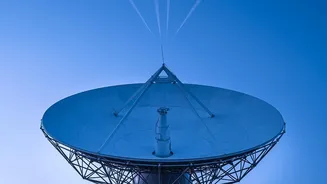
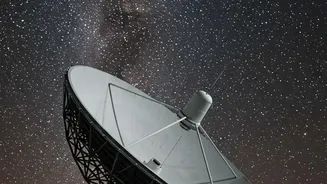
Imagine a radio telescope so vast it spans two continents. That’s the reality of the Square Kilometre Array Observatory. It isn't a single dish but a network of thousands of antennas working together as one colossal instrument. The project is split across
two locations to cover different radio frequencies. In South Africa, the SKA-Mid array consists of nearly 200 large dish antennas that will scan mid-range frequencies. In Australia, the SKA-Low array uses over 130,000 smaller, tree-like antennas to pick up low-frequency signals. Construction on this massive global project officially began in late 2022, and with early science operations now commencing, it marks a new era in astronomy. Headquartered in the UK, the SKAO is one of the most significant international scientific collaborations of the 21st century, bringing together 16 member countries.
Hunting the 'Cosmic Dawn'
The primary mission of the SKAO is to detect signals from a period known as the 'Cosmic Dawn'. This era, which occurred a few hundred million years after the Big Bang, is when the very first stars and galaxies began to form, ending the cosmic 'dark ages'. These first celestial bodies were incredibly faint, and their light has been travelling for over 13 billion years to reach us. The SKAO will be looking for the faint radio signal emitted by neutral hydrogen, the most abundant element in the early universe. This signal, which has a wavelength of 21cm, gets stretched as the universe expands. By detecting these stretched-out radio waves, astronomers can essentially create a 3D map of the early universe and witness the moment it first lit up. The SKA-Low telescope in Australia is specifically designed for this challenging task.
India's Crucial Role in the Cosmic Quest
India is a full member of the SKAO consortium and a vital contributor to the project. The Indian government has committed Rs 1,250 crore to the endeavor, cementing its position at the forefront of global radio astronomy. The National Centre for Radio Astrophysics (NCRA) in Pune is coordinating India's involvement, which is extensive. Indian scientists and engineers have played a leading role in designing the Telescope Manager system — the complex software 'brain' that will control the entire observatory's operations. This is akin to designing the central nervous system for the world's most advanced telescope. Furthermore, India is leveraging the expertise gained from operating its own world-class facility, the Giant Metrewave Radio Telescope (GMRT), which serves as an important pathfinder for SKAO science. Indian institutions are also gearing up to establish a regional data centre to process the immense amount of data the SKAO will generate.
Beyond the First Stars
While observing the Cosmic Dawn is a headline goal, the SKAO's capabilities will allow it to tackle a wide range of astronomical mysteries. Scientists will use the telescope to test Albert Einstein's theories of gravity with extreme precision by timing signals from pulsars, which are rapidly rotating neutron stars. The observatory will also survey billions of galaxies, creating a map of the large-scale structure of the universe to help us better understand the enigmatic forces of dark matter and dark energy. Its incredible sensitivity will also make it a powerful tool in the search for cosmic transients like Fast Radio Bursts (FRBs) and may even help in the search for complex molecules and the building blocks of life elsewhere in the galaxy. The sheer discovery potential means that some of the most exciting finds from the SKAO may be things nobody has even predicted yet.