




The Cosmic Nursery's Old Rules
For a long time, the story of how stars are born seemed relatively straightforward. In the vast, cold expanse of space, giant clouds of gas and dust, known as molecular clouds, slowly collapse under their own gravity. Over millions of years, dense clumps
within these clouds pull in more and more material, heating up until nuclear fusion ignites at their core, and a new star blazes to life. This process was thought to be a slow, steady, and somewhat isolated affair, happening in pockets across a galaxy. We believed that the mass of a star cluster, for instance, didn't significantly change how quickly it burst forth from its dusty cocoon. This was the textbook model, a reliable framework for understanding the stellar life cycle.
A Tale of Two Telescopes
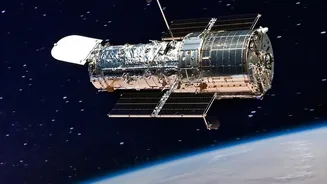
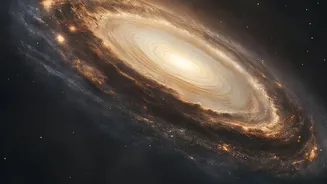
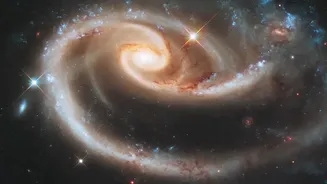
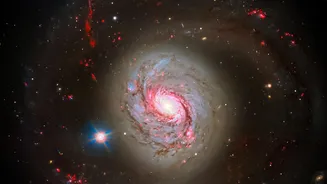
Recent observations, however, have begun to complicate this tidy picture. A one-two punch from two of humanity’s most powerful eyes on the sky, the Hubble Space Telescope and the James Webb Space Telescope (JWST), has provided a flood of new data. Using Hubble, astronomers recently studied our cosmic neighbour, the Andromeda galaxy. They found that its rate of star formation has been declining for the last 500 million years, with a particularly sharp drop in just the last 40 million years. This suggests galactic-scale events can put the brakes on starbirth. Meanwhile, JWST’s infrared vision has been peeling back the dusty curtains of stellar nurseries to reveal the process in unprecedented detail. Its ability to see through gas clouds that are opaque to other telescopes is fundamentally changing the game.
Rewriting the Stellar Cookbook
The new clues suggest that star formation is a much more complex and dynamic process than previously imagined. For one, it seems mass matters a great deal. A recent study combining Hubble and JWST data found that the most massive star clusters blow away their natal clouds much faster—in about five million years—than their smaller counterparts. This has major implications, as the intense radiation from these emerging giant stars can affect the formation of planets around neighbouring, smaller stars. JWST has also revealed that the outflows from young stars are more intricate than we knew, sometimes appearing in aligned jets that suggest they formed along the same powerful magnetic field lines, like beads on a string. This hints at a more structured and interconnected process, rather than a random collapse of gas.
Galaxies as Active Players
Perhaps the biggest shift in thinking is the role of the galaxy itself. The findings from Andromeda show that star formation isn't just a local event; it's tied to the galaxy's overall evolution. Other discoveries are reinforcing this. Astronomers studying galaxies in the early universe, when the cosmos was just a fraction of its current age, are finding that star formation may have happened much more efficiently and rapidly than our models predicted. Some of these primordial galaxies were creating stars at hundreds of times the rate of our own Milky Way today. This forces us to reconsider how the first galaxies grew so massive so quickly. Instead of just being a passive container for stars, the galaxy appears to be an active system whose conditions—like its chemistry, density, and magnetic fields—directly dictate the speed and style of starbirth.
Why These Cosmic Clues Matter
Understanding how stars form is about more than just satisfying cosmic curiosity. Every element heavier than hydrogen and helium was forged inside a star. The birth of stars is inextricably linked to the birth of planets and, ultimately, the potential for life. When we learn that the environment around a young star is rich in complex organic molecules and water ice, as JWST has shown, we get a glimpse into the starting materials available for planets like our own. By refining our models of star formation, we are rewriting our own cosmic origin story. These new observations remind us that the universe is not a static museum, but a dynamic and evolving place, still full of secrets waiting to be uncovered.