





Why Your Desk Job Is So Tough on Your Body
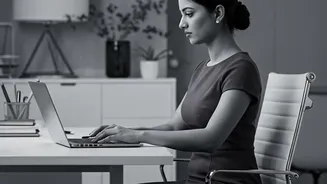
Our bodies are designed for movement, but modern work often involves hours of sitting still. When you're focused on a screen, your head tends to drift forward. For every inch your head moves forward, the strain on your cervical spine increases significantly.
This 'forward head posture' forces the muscles in your neck and upper back to work overtime just to hold up your head, which weighs about as much as a bowling ball. Over an eight-hour day, this leads to muscle fatigue, stiffness, and pain. Rounded shoulders and slouching only make it worse by tightening chest muscles and weakening the back muscles that provide support. Repetitive motions like typing and using a mouse can also contribute to tightness. The good news is that incorporating small, mindful movements throughout your day can counteract these effects, improve circulation, and release built-up tension.
1. Seated Cat-Cow
This classic yoga pose is perfect for waking up a stiff spine and can be easily adapted for your chair. It helps improve flexibility and activates core muscles. Sit on the edge of your chair with your feet flat on the floor and your hands on your knees. On an inhale, arch your back, push your chest forward, roll your shoulders back, and look up toward the ceiling (Cow pose). As you exhale, round your spine, tuck your chin to your chest, and draw your belly button inward (Cat pose). Flow between these two positions for 8-10 breaths, matching your movement to your breath. This gentle movement mobilises the entire spine, relieving tension from the lower back all the way up to the neck.
2. Gentle Neck Rolls and Tilts
This is a direct and effective way to target the muscles along the sides and back of your neck. Sit tall and relaxed. First, slowly drop your chin toward your chest. Then, gently roll your right ear toward your right shoulder, holding for a few deep breaths. Be careful not to raise your shoulder to meet your ear. Slowly roll your head back through the center and over to the left side. Repeat this 3-5 times on each side. Avoid rolling your head all the way back, as this can compress the vertebrae in your neck. This simple exercise helps release the levator scapulae muscles, which run from your neck to your shoulder blades and often become tight from desk work.
3. Seated Spinal Twist
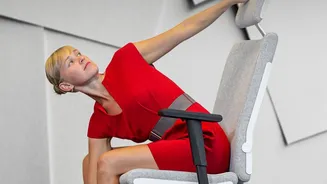
A gentle twist can help relieve tension in the upper and mid-back, which contributes to shoulder pain. Sit sideways in your chair or at the edge, with your feet firmly on the floor. Inhale to lengthen your spine, sitting up as tall as possible. As you exhale, gently twist your torso to the right, using the back of the chair for light leverage. Place your left hand on your right knee to deepen the stretch. Hold for 3-5 deep breaths, continuing to lengthen on each inhale and gently twisting more on each exhale. Slowly return to the center and repeat on the other side. Twists are excellent for improving mobility and releasing the muscles that run alongside the spine.
4. Chair Eagle Arms
This pose provides a deep stretch for the upper back and the area between the shoulder blades, which is often tight and hard to reach. Extend your arms straight out in front of you. Cross your right arm under your left at the elbows. Bend your elbows and wrap your forearms around each other, trying to bring your palms together. If your palms don't touch, simply press the backs of your hands against each other. Gently lift your elbows to shoulder height while drawing your shoulders down, away from your ears. You should feel a stretch across your upper back. Hold for 5 deep breaths, then unwind and repeat with the left arm under the right.
5. Shoulder Shrugs and Rolls
This is perhaps the simplest and most intuitive movement for releasing shoulder tension. While seated or standing, inhale and lift your shoulders up toward your ears, squeezing them tightly. Hold for a moment, then exhale and release them completely, letting them drop down. Repeat this 5-10 times. Next, roll your shoulders backward in large, slow circles for five repetitions, then reverse the direction and roll them forward for another five. This simple sequence helps release the trapezius muscles, which are the large muscles that span your neck, shoulders, and back and carry a lot of stress from desk work.