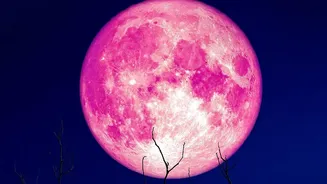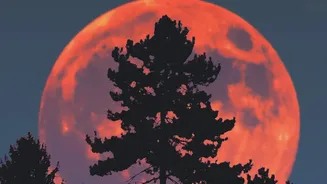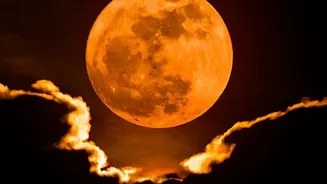



Meet the Hunter's Moon
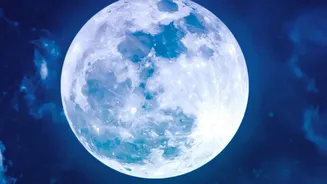
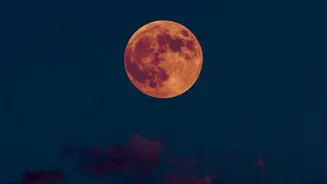
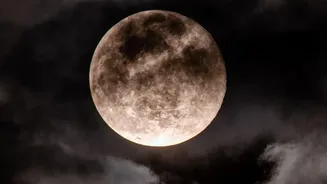
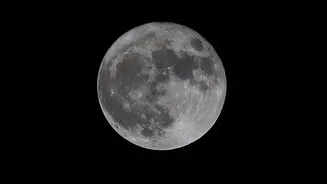
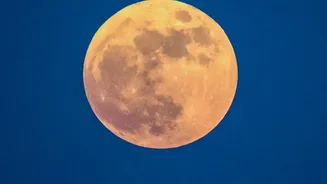
The full moon of October is traditionally known as the Hunter's Moon. It's the full moon that directly follows the Harvest Moon, which is the one closest to the September equinox. This year, the Hunter's Moon will be visible in its full glory around October 25th
and 26th. Its name comes from an era when its bright light, rising shortly after sunset, would help hunters spot prey in the recently cleared fields, gathering food for the winter ahead. But its most fascinating quality isn’t its name, but its timing.
The Usual 50-Minute Delay
Normally, the moon rises about 50 minutes later each day. This happens because as the Earth spins on its axis, the moon is also orbiting our planet. Each day, the moon moves about 12 to 13 degrees eastward in its orbit. This means the Earth has to rotate a little extra each day to 'catch up' to where the moon has moved, causing moonrise to be progressively later. This nearly hour-long delay is the standard rhythm of our lunar companion. However, in autumn, something changes.
It's All About the Angle
The secret behind the Hunter's Moon effect lies in the angle of the moon's path relative to the horizon. Imagine the ecliptic—the apparent path the sun and moon travel across the sky. The moon’s orbit is tilted slightly compared to the ecliptic, but it generally follows this same highway through the stars. During the autumn months in the Northern Hemisphere, the ecliptic makes a very shallow, almost parallel, angle with the eastern horizon at sunset. Think of it as a ramp that is nearly level with the ground.
How a Shallow Angle Changes Everything
Because of this shallow angle, the moon's daily eastward movement along its orbit translates into less of a delay in its appearance above the horizon. Instead of climbing 'up' and away from the horizon, it moves more 'sideways' along it. As a result, the Earth doesn't need to turn as much to bring the moon back into view on successive nights. This reduces the usual 50-minute delay to as little as 20 to 30 minutes for observers at mid-northern latitudes. The effect is even more dramatic the farther north you go, with delays shrinking to just a few minutes in places like Alaska or Scotland.
A Legacy of Light
This celestial quirk provided a natural advantage in pre-industrial times. For several evenings in a row, the landscape was bathed in bright moonlight shortly after sunset, with no long stretch of darkness in between. For farmers bringing in the last of their crops (during the Harvest Moon) and for hunters stocking up for winter (during the Hunter's Moon), this reliable evening light was an invaluable resource. So while it may not actually be bigger or brighter, the Hunter's Moon offered a predictable and useful gift of extended light when the days were growing shorter. It's a beautiful reminder of how celestial mechanics once directly shaped human life.