




What Exactly Is a Moon Pairing?
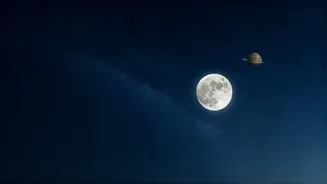
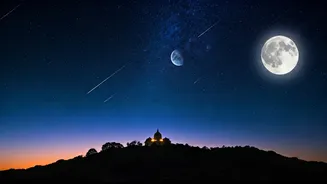
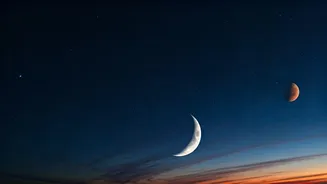
When we talk about a 'moon pairing' or a 'conjunction', we're describing a captivating line-of-sight illusion. From our perspective here on Earth, two celestial objects, such as the Moon and a planet, appear to pass very close to one another in the sky.
They aren't physically close, of course — the distances are still astronomical — but they align in a way that creates a striking visual pairing. These events are a delight for stargazers because they are often bright enough to be seen with the naked eye, even from urban areas. They provide a fantastic opportunity to identify planets that you might not otherwise notice. As the Moon travels along its orbit, it regularly passes by the same planets, offering a different beautiful tableau each month. This July, it has scheduled close approaches with three of the brightest planets in our sky, creating a celestial schedule you won't want to miss.
An Early Rendezvous: The Moon and Saturn
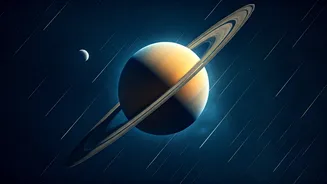
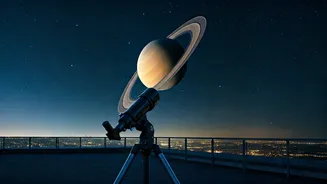
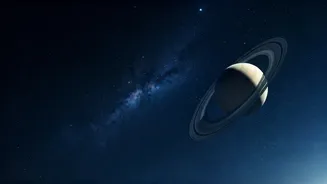
The first major event on our stargazing calendar occurs on the nights of July 7th and 8th. The waning Moon will have a close encounter with the magnificent ringed planet, Saturn. To see this, you'll need to be either a night owl or an early riser. The pair will climb above the eastern horizon just after midnight and journey across the sky together until the light of dawn washes them out. Saturn will appear as a bright, steady, golden-hued point of light that, unlike stars, doesn't twinkle. The presence of the easily identifiable Moon makes locating Saturn incredibly simple. While the pairing is a beautiful sight to the naked eye, those with a small telescope will be rewarded with a view of Saturn's iconic rings, which currently appear unusually thin from our vantage point on Earth.
A Trio in the East: The Moon, Mars, and Pleiades
Just a few days later, on the mornings of July 10th and 11th, the Moon continues its planetary tour, this time visiting Mars. This will be another pre-dawn spectacle, visible in the eastern sky about an hour and a half before sunrise. A slim crescent Moon will form a stunning grouping with the fiery red planet. Adding to the beauty of this scene is the nearby Pleiades star cluster, also known as the Seven Sisters. This tight bundle of bright blue-white stars provides a glittering backdrop to the celestial alignment. The combination of the delicate crescent Moon, the distinct reddish glow of Mars, and the sparkling Pleiades will make for a truly memorable and photogenic gathering in the morning twilight. It’s a perfect opportunity to see three distinct and beautiful celestial objects in one patch of sky.
An Evening Showstopper: The Moon and Venus
For those who prefer evening skywatching, the best is saved for July 16th and 17th. On these dates, a young, thin crescent Moon will have a close meeting with the brightest planet of them all, Venus. This pairing will be visible in the western sky shortly after sunset. Venus is impossible to miss; its dazzling, silvery light easily cuts through the evening twilight. The Moon will appear nearby, and on the 16th, it will also be close to Regulus, the brightest star in the constellation Leo, creating a temporary celestial trio. This conjunction is one of the most accessible and rewarding events of the month, as it happens at a convenient time and is bright enough to be seen from almost anywhere, even in light-polluted cities. It's a simple, yet profound, reminder of the clockwork beauty of our solar system.
Tips for the Best Viewing Experience
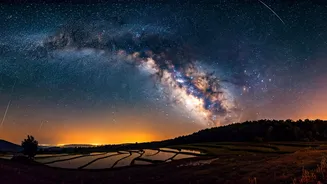
You don't need expensive equipment to enjoy these sights; all the pairings mentioned are visible to the naked eye. However, a pair of binoculars will certainly enhance the view, bringing out more color and detail, especially on the Moon's surface and in the Pleiades star cluster. For the best experience, try to find a location with a clear view of the horizon, away from the direct glare of streetlights. Give your eyes about 15-20 minutes to adapt to the darkness; you'll be surprised how many more stars become visible. For those in India, the primary challenge during this season can be the monsoon clouds. It’s a good idea to check the local weather forecast and be ready to take advantage of any clear spells. Patience is key. Even a brief break in the clouds can offer a spectacular glimpse of these cosmic meetings.