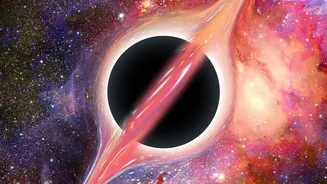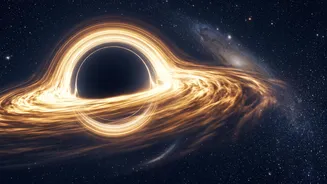







For decades, physicists have operated under a core assumption: black holes can merge, but they can never split. New theoretical research now challenges this, suggesting a rare loophole might allow a single black hole to divide in two.
A Crack in Cosmic Law
In the universe,
some rules seem absolute. One of them, derived from Einstein's theory of general relativity and Stephen Hawking's area theorem, is that the total surface area of a black hole's event horizon can't decrease. This effectively means two black holes can merge into one larger one, but a single black hole can't split into two smaller ones, as this would decrease the total entropy, or disorder, of the system. This principle has been a cornerstone of black hole mechanics for over 50 years. However, a new study published in the journal Physical Review D suggests this law might not be so absolute after all. An international team of physicists has identified a theoretical pathway for a black hole to do the unthinkable: split apart.
The Power of Spin
The key to this potential cosmic rebellion is spin. While a stationary, non-rotating black hole is thermodynamically forbidden from splitting, the situation changes dramatically for a black hole rotating at an exceptionally high speed. The researchers found that a spinning black hole has less entropy than a non-rotating one of the same mass. This creates a potential 'loophole'. If a spinning black hole were to split, its spin energy could be converted into the orbital energy of the two new, smaller black holes moving apart. This conversion could potentially balance the entropy equation, making the split thermodynamically possible, something previously thought to be disallowed.
The 'Exceptionally Extreme' Catch
Before we imagine the universe filled with self-replicating black holes, it's crucial to understand the 'exceptionally extreme' part of the scientists' claim. The conditions required are incredibly restrictive. Just overcoming the entropy barrier isn't enough; the two newly formed black holes must also have enough momentum to escape each other's immense gravity. If they don't, they would immediately fall back and merge into one again. According to the researchers, this escape is only possible if the original black hole is spinning at, or very close to, its absolute maximum physical limit. This narrows the window of opportunity for a split from 'unlikely' to 'extraordinarily rare'.
A Pair-of-Pants in Spacetime
The study's title, 'When Black Holes Admit Pair-of-pants Topologies', offers a curious visual for this complex process. It describes the shape the black hole's event horizon—the boundary of no return—would trace through spacetime if it were to split. It would start as a single 'tube' and then bifurcate into two separate 'legs', resembling a pair of trousers. This is more than just a quirky name; it represents a fundamental shift in how the fabric of spacetime itself would behave, allowing for a topology that classical theories generally forbid. The research suggests this is more likely to happen if one of the resulting black holes is significantly smaller than the other.
From Theory to Observation?
For now, a black hole splitting remains purely theoretical. No such event has ever been observed, and the study doesn't claim it's a common occurrence. The probability of a split happening depends on aspects of gravity that go beyond Einstein's current theories. However, the scientists suggest there may be ways to look for indirect evidence. They theorise that smaller, primordial black holes from the early universe might be more prone to splitting than the massive ones we typically observe. If these splits do occur, they could release high_energy signals, such as gamma_rays. Telescopes like the Fermi_LAT could potentially search for these tell_tale signatures, offering a way to test this mind_bending new idea.