





A Gift from Halley's Comet
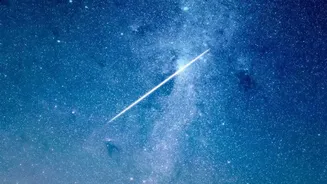
The Orionid meteor shower is one of the most reliable and beautiful of the year. These shooting stars are actually tiny, fast-moving pieces of debris left behind by the most famous comet of all, Halley's Comet. Each October, Earth passes through this
trail of cosmic dust. As the particles hit our atmosphere at high speed—about 66 kilometres per second—they burn up, creating the brilliant streaks of light we call meteors. They are named Orionids because they appear to radiate from a point near the constellation Orion, the Hunter.
Mark Your Calendar: Prime Viewing Time
The Orionids are active from early October to early November, but the best time to watch is during the peak. In 2026, the peak occurs on the night of October 21-22. The prime viewing window is in the pre-dawn hours, after midnight. This year, a bright moon will be present in the earlier part of the night but is expected to set a few hours before dawn, opening up a darker window of opportunity for stargazers. Patience will be key, as the shower is expected to produce about 15 to 20 meteors per hour under ideal, dark-sky conditions; in a city, this number will be lower.
Find Your Urban Observatory
The biggest challenge in any Indian city is light pollution, which can wash out fainter meteors. But you don't necessarily need to drive for hours. Your goal is to find the darkest possible spot available to you. This could be a local park (if safely accessible at night), a high-rise rooftop, or even a balcony that faces away from major streetlights and commercial areas. The higher up you can get, the better, as it puts more distance between you and ground-level light sources. Any location with a wide, unobstructed view of the sky is a good candidate.
The Best Equipment Is Your Eyes
The headline is right: no heavy telescope is needed. In fact, telescopes and even binoculars are not ideal for meteor showers. Their narrow fields of view mean you're likely to miss the show. Meteor showers are best watched with the naked eye, allowing you to take in as much of the sky as possible. The key is to recline comfortably in a chair or lie on a blanket, look up, and simply watch a large patch of sky. While the meteors radiate from Orion, they can appear anywhere, and the longest, most dramatic streaks often occur 45 to 90 degrees away from the radiant point.
Let Your Eyes Adjust
This is the single most important tip for urban stargazing. Your eyes need at least 20 to 30 minutes of complete darkness to become fully 'dark-adapted'. This means no looking at your phone, no streetlights in your direct line of sight, and no turning on flashlights (unless they have a red filter). Once your eyes adjust, you'll be amazed at how many more stars become visible, which dramatically increases your chances of spotting the fainter Orionid meteors that would otherwise be invisible against the city skyglow.
Patience and What to Expect
Meteor watching is a game of patience. Don't expect a constant fireworks display. You might watch for 15 minutes and see nothing, then spot two or three in quick succession. The experience is about the quiet anticipation and the thrill of a sudden, fleeting streak of light. Some Orionids are known for being particularly bright and leaving persistent 'trains'—glowing trails of ionized gas that can linger for a few seconds after the meteor has vanished. While stargazing apps on your phone can help you locate the constellation Orion, be sure to use their 'night mode' or red-light filter to preserve your night vision.