



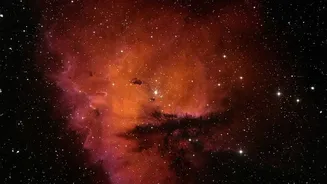
A Star's Beautiful, Final Act
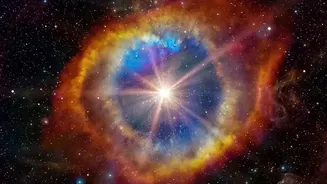
Located about 650 light-years away, the Helix Nebula isn't a nebula in the traditional sense of a stellar nursery. It's a planetary nebula, which has nothing to do with planets. The name is a historical holdover because their round shapes reminded early
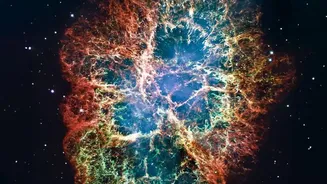
astronomers of planets. In reality, it's the beautiful death shroud of a star much like our own sun. As the star ran out of fuel, it blew its outer layers of gas and dust into space. At its center now sits a tiny, intensely hot white dwarf—the star's leftover core—whose fierce radiation makes the expanding shells of gas glow. This process recycles stellar material back into the cosmos, providing the raw ingredients for future stars and planets.
What Are Those Mysterious 'Knots'?
For decades, astronomers have been fascinated by thousands of features inside the nebula called "cometary knots." They're not actually comets, but they look like them, with bright heads and long, streaming tails pointing away from the central star. These are gigantic structures. Each knot's dense, gaseous head is roughly twice the size of our solar system, and their tails can stretch for 100 billion miles. They are essentially massive, dense clumps of molecular gas and dust that are more resilient to the stellar wind and radiation blowing from the central white dwarf. Think of them as dense boulders in a fast-moving river; the water (or in this case, stellar wind) flows around them, creating a tail downstream.
The Infrared Advantage: Seeing Through the Veil
So, why does Webb make them stand out so clearly? The answer is infrared light. Much of the universe is filled with cosmic dust, which acts like a thick fog for telescopes that see in visible light, the kind our eyes detect. The shorter wavelengths of visible light scatter and get blocked by this dust. However, infrared light has a longer wavelength that can pass through the dusty clouds much more easily. It’s like having special glasses that let you see through smoke. This ability allows Webb to peer into the dense, dusty hearts of the cometary knots, revealing their structure and composition in a way that telescopes like Hubble, which primarily sees in visible and ultraviolet light, cannot. Webb’s view brings the knots to the forefront, making them pop with clarity against the rest of the nebula.
Webb’s Specialized Toolkit for the Job
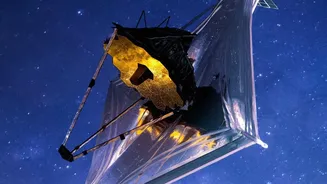
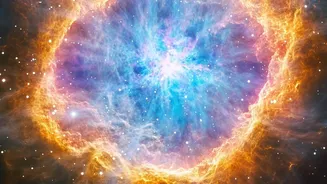
The James Webb Space Telescope uses its Near-Infrared Camera (NIRCam) to get these spectacular shots. NIRCam is perfectly tuned to detect the faint, warm glow of molecular hydrogen, which is abundant within the cooler, denser knots. In the images Webb produces, different colors are assigned to different infrared wavelengths, which helps scientists map the nebula's chemistry and temperature. The hottest gas, blasted by radiation from the central star, appears blue. Cooler regions where hydrogen molecules are forming appear yellow, and the coldest, dustiest material at the edges of the knots glows in red tones. This detailed color-coding allows astronomers to see the stark transition from hot, ionized gas to the cool, protected pockets inside the knots where the building blocks of new celestial bodies might be forming.