




A Journey to a Metal World
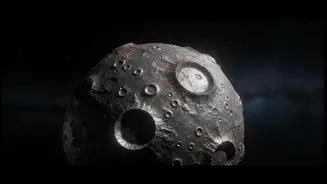
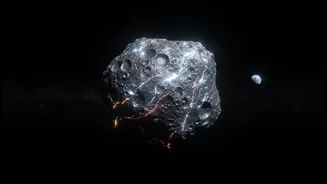
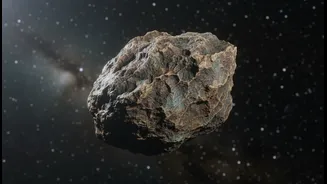
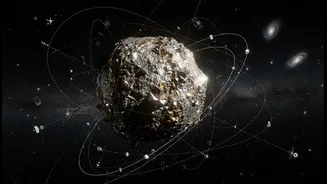
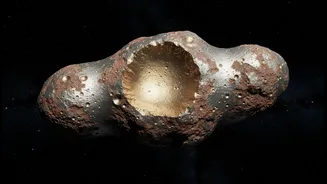
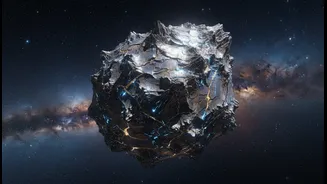
The asteroid 16 Psyche, located in the main asteroid belt between Mars and Jupiter, is unlike any world we have visited before. While most asteroids are rocky or icy, Psyche appears to be composed largely of metal. Scientists believe it could be the exposed
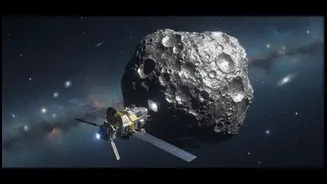
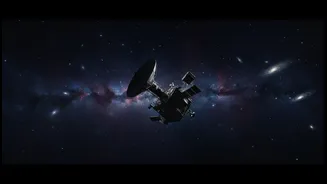
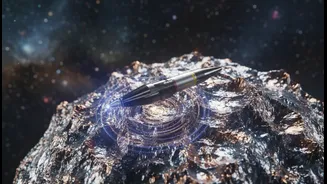
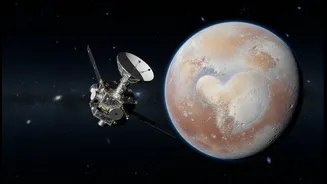
nickel-iron core of a protoplanet—a small, early planet that was destroyed in ancient collisions, its rocky outer layers stripped away. This provides a rare opportunity. We can't drill down to Earth's core, but by visiting Psyche, we might be able to study the building block of a terrestrial planet up close. NASA's Psyche spacecraft, launched in October 2023, is on a long journey to do just that, scheduled to arrive at the asteroid in August 2029.
Hunting for a Magnetic Ghost
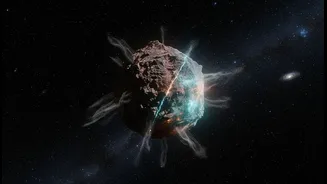
One of the mission's most fascinating goals is to find out if Psyche has a magnetic field. Earth generates a powerful magnetic field from the churning of its molten liquid outer core, a process known as a dynamo. A small, solid body like an asteroid wouldn't have an active dynamo today. However, if Psyche was once the molten core of a protoplanet, it would have generated its own magnetic field billions of years ago. As the core cooled and solidified, that magnetic signature could have been “frozen” into its metallic structure. Finding evidence of this “remanent magnetization” would be the single most definitive proof that Psyche is, indeed, an ancient planetary core. It would be like finding a fossil of a magnetic field, a ghost of the asteroid’s dynamic past.
The Right Tool: A Pair of Magnetometers
To hunt for this phantom field, the Psyche spacecraft is equipped with a specialized instrument simply called the Magnetometer. But this isn't just one sensor. It's a sophisticated setup composed of two identical, highly sensitive fluxgate sensors. These sensors are designed to detect and measure the direction and strength of magnetic fields around the spacecraft. The entire instrument suite is a collaboration between the Massachusetts Institute of Technology (MIT) and the Technical University of Denmark (DTU), bringing world-class expertise to this interplanetary investigation.
A Clean Signal in a Noisy Environment
Measuring a potentially faint magnetic field from an asteroid millions of kilometers from Earth is incredibly challenging. A major hurdle is that the spacecraft itself generates its own magnetic fields from its electronics, solar arrays, and thrusters. To solve this, engineers mounted the two magnetometer sensors on a nearly 7-foot (2-meter) boom, extending them away from the main body of the spacecraft. Placing the sensors at different points on the boom—one in the middle and one at the far end—allows scientists to perform a clever technique called gradiometry. By comparing the readings from the two sensors, the science team on the ground can mathematically cancel out the magnetic 'noise' from the spacecraft, isolating the clean signal of any magnetic field originating from the asteroid itself. This ensures that what they detect is genuinely from Psyche.
A Dance of Detection and Discovery
The measurement process will be a patient and precise dance. The magnetometer was powered on shortly after launch to give the team years to understand the spacecraft's magnetic signature during its cruise phase. Once it arrives at Psyche in 2029, the spacecraft will enter a series of different orbits, getting progressively closer to the surface. During these orbits, the magnetometers will be constantly gathering data, which will be beamed back to Earth through the Deep Space Network. Scientists will use this data to build up a three-dimensional map of Psyche’s magnetic field. This map will not only tell them if a field exists but also reveal its strength and structure, offering profound insights into the asteroid’s composition and violent history.