



Smarter Rovers and Autonomous Navigation
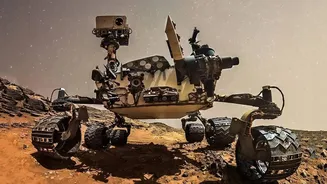
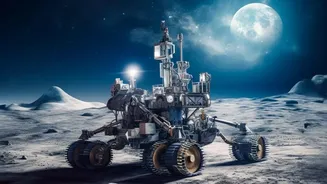
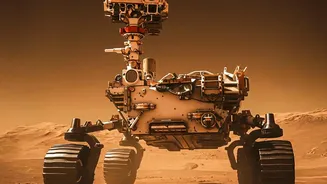
One of the most visible applications of AI at NASA is on the surface of Mars. The Perseverance rover, for instance, relies heavily on AI for autonomous navigation. It can analyze images of the terrain in real-time, identify hazards like large rocks or steep
slopes, and plot the safest and most efficient path forward without waiting for commands from mission control on Earth. This capability is crucial, given the communication delay between the two planets. The rover’s AI-powered instrument, PIXL, also helps it search for signs of ancient life by autonomously analyzing rock samples. Similarly, the Curiosity rover uses AI to select its own targets for laser chemical analysis, allowing it to make scientific decisions on the fly.
Discovering New Worlds in Data
The universe is vast, and NASA's telescopes collect an overwhelming amount of data every day. Sifting through this cosmic haystack for scientifically valuable needles is a monumental task for humans alone. This is where AI excels. A deep learning system called ExoMiner analyzed data from the Kepler Space Telescope and successfully identified 301 previously unknown exoplanets. AI models are trained to spot the faint, tell-tale patterns in starlight that indicate a planet is passing by, filtering out noise and flagging candidates for scientists to review. Beyond finding planets, machine learning is also used to analyze light curves to predict cosmic events like supernovae and help identify gravitational waves.
A Sharper Eye on Planet Earth
AI's impact isn't limited to distant worlds; it's also revolutionizing how we monitor our own planet. NASA has accumulated decades of Earth observation data, creating one of the world's largest environmental archives. This data is so vast that it's impossible for researchers to analyze manually. By partnering with companies like IBM, NASA is using AI to analyze satellite imagery and climate data to identify patterns, track deforestation, monitor melting ice sheets, and even predict extreme weather events. These AI-driven insights help scientists understand planetary change and provide critical information for disaster relief efforts.
The Future of AI in Space
NASA is committed to integrating AI even more deeply into its future missions. The agency is developing next-generation, radiation-hardened computer chips specifically designed for onboard AI, which could deliver performance hundreds of times greater than current spaceflight computers. This technology will enable fully autonomous spacecraft that can respond to unexpected events in deep space where communication delays make human intervention impractical. Looking ahead, NASA envisions AI assistants for astronauts on future missions to the Moon and Mars, helping with everything from habitat monitoring to vehicle operations and astronaut health. Initiatives like the Genesis Mission and the NASA 2040 AI Track are formalizing this strategy, aiming to use AI to process petabytes of archival data and accelerate the pace of discovery.