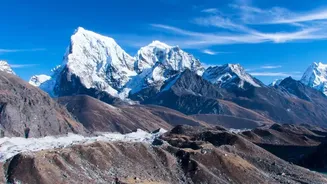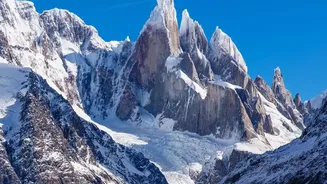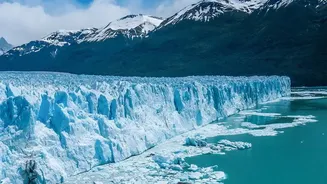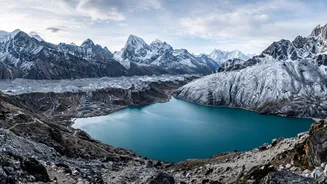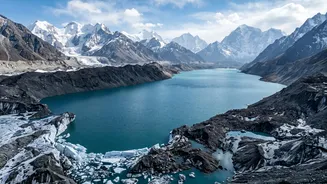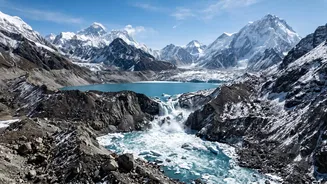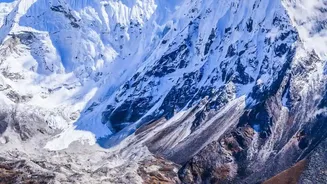







High in the Himalayas, thousands of glacial lakes are swelling, creating 'ticking time bombs' that threaten downstream communities. New reports from the UN highlight a growing risk of sudden, catastrophic floods for millions across the region.
What is a Glacial Lake Outburst Flood?
A Glacial
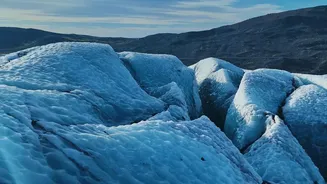
Lake Outburst Flood, or GLOF, is a sudden and violent release of water from a lake formed by melting glaciers. As glaciers retreat due to rising temperatures, they leave behind massive depressions that fill with meltwater. These lakes are often dammed by unstable barriers of loose rock and ice, known as moraines. When this natural dam fails—due to pressure from rising water levels, an avalanche, or a landslide—it unleashes a devastating torrent of water, mud, and boulders down the narrow mountain valleys. These floods can travel hundreds of kilometres, destroying everything in their path with very little warning.
The UN's Sobering Assessment
A series of recent reports paint a grim picture. Ahead of the COP31 climate conference, the UN Environment Programme and the International Cryosphere Climate Initiative released findings indicating that the world's frozen regions are warming much faster than the global average. The Hindu Kush Himalayas are experiencing accelerated warming, making glaciers dangerously unstable. A separate, pre-publication UN-led study analysing GLOF events between 1835 and 2025 found that India has suffered the highest number of recorded deaths in the region, with over 6,100 fatalities. The frequency of these disastrous floods has surged, with the number of events per decade nearly five times higher than before 1950. These reports serve as a stark warning that overshooting the 1.5°C global warming target could lead to largely irreversible ice loss, dramatically increasing the GLOF threat.
Who Is Most at Risk?
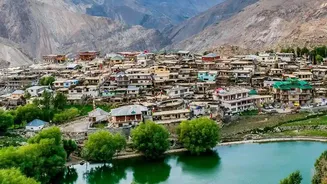
The threat looms over the entire Hindu Kush Himalaya region, but downstream communities in India, Pakistan, Nepal, and Bhutan are particularly vulnerable. Research has identified hundreds of potentially dangerous glacial lakes across the region. In India, several Himalayan states face significant risks. The Jammu and Kashmir government recently acknowledged that 68 of its 616 identified glacial lakes are potentially dangerous, threatening districts like Kishtwar and Anantnag. Studies have also highlighted growing risks in the Alaknanda Basin in Uttarakhand and across Sikkim. The danger is transboundary; a recent GLOF from Bhutan's Sintaphu Lake in late October 2026 prompted immediate flood alerts in downstream districts of West Bengal and Assam. With millions of people, critical infrastructure like roads and hydropower projects, and entire towns located in these river valleys, the potential for catastrophic loss of life and property is immense.
A Reality Etched in Past Disasters
For many in the Himalayas, this threat is not abstract. The 2013 Kedarnath tragedy in Uttarakhand, triggered by the Chorabari glacial lake outburst, resulted in thousands of deaths and widespread destruction. More recently, the 2023 GLOF from South Lhonak Lake in Sikkim killed dozens and caused massive damage to infrastructure. These events, along with devastating floods in Nepal in August 2026 that killed hundreds, serve as brutal reminders of the speed and power of these mountain hazards. Scientists say that climate change is not just melting glaciers but also destabilising the entire mountain system, loosening rock and increasing the likelihood of landslides that can trigger GLOFs. The landscape is changing faster than ever, with the number and size of glacial lakes expanding rapidly since the 1990s.
Can This Threat Be Managed?
While the situation is critical, experts stress that action can be taken to mitigate the risk. The key lies in better monitoring and the implementation of robust early warning systems. Scientists use satellite imagery and field surveys to identify and rank the most dangerous lakes, but many remote areas remain poorly monitored. For high_risk lakes, engineering solutions like controlled drainage can reduce water levels and pressure on unstable dams. However, a UN official noted that technology is not advancing fast enough to prevent all downstream damage. Ultimately, effective disaster management requires not just technology but also transboundary cooperation between countries sharing river basins, and people_centred early warning systems that provide clear, timely guidance to vulnerable communities on what to do when an alert is issued.