



A Fortress Against the Void
Creating a safe space habitat is fundamentally about building a self-contained world. It must protect its inhabitants from the vacuum of space, extreme temperature swings from over 120°C in sunlight to -157°C in shadow, and constant threats from radiation
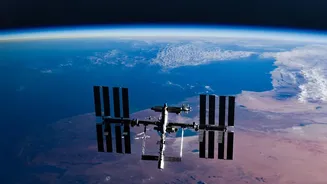
and debris. Companies like Axiom Space and Sierra Space are pioneering new habitats, moving beyond the purely functional design of early space stations toward environments built for long-duration commercial missions. This requires a multidisciplinary approach blending engineering, biology, and human psychology. The primary structure itself is the first line of defense. Axiom's modules, built by Thales Alenia Space, use rigid metallic structures, while Sierra Space's LIFE (Large Integrated Flexible Environment) habitat is an inflatable module. These inflatable structures aren't like balloons; they are made of high-strength soft materials like Vectran, similar to Kevlar, which become rigid when pressurized and offer excellent protection. In fact, a full-scale LIFE habitat exceeded NASA's safety requirements in a burst-pressure test, demonstrating its structural integrity.
Shielding from Invisible Dangers
Two of the most persistent dangers in orbit are radiation and micrometeoroids. Without Earth's magnetic field and thick atmosphere, astronauts are exposed to cosmic rays and solar flares that can pose long-term health risks. Designers use multi-layered shielding to mitigate this. Materials rich in hydrogen, like polyethylene, are effective at absorbing this radiation. Some design concepts even strategically place water storage and other supplies around crew quarters to provide an extra layer of shielding. For micrometeoroids and orbital debris (MMOD)—tiny particles traveling at immense speeds—engineers employ a technology called a Whipple shield. This system uses a thin outer sacrificial wall set at a distance from the main habitat wall. When a particle strikes the bumper, it shatters and spreads the impact energy over a wider area of the inner wall, preventing a puncture. These shields are critical for protecting modules from the constant threat of high-velocity impacts.
The Life Support Loop
Inside the habitat, the most critical system is the one that keeps astronauts breathing. The Environmental Control and Life Support System (ECLSS) is the mechanical heart, lungs, and kidneys of a space station. These sophisticated systems don't just provide oxygen; they actively manage the entire atmosphere. They scrub carbon dioxide exhaled by the crew, control humidity, and maintain a steady temperature and pressure. For long-term commercial outposts, sustainability is key. The ECLSS on the International Space Station (ISS) recycles about 90% of its water from sources like crew breath, sweat, and even urine, purifying it into drinkable water. Future commercial habitats aim to improve this efficiency further, creating a closed-loop system that minimizes the need for expensive resupply missions from Earth. This technology is what makes long-duration stays in orbit economically viable.
Designing for the Human Mind
A habitat can be structurally sound and have perfect air, but if it breaks the human spirit, the mission will fail. Isolation, confinement, and the disruption of normal day-night cycles are significant psychological stressors for astronauts. Designers are now incorporating principles of psychology and human-centric design to create environments that support mental well-being. This includes providing private crew quarters for solitude, which are essential for psychological resilience. Axiom's modules feature large Earth-viewing windows in each crew quarter, helping to reduce feelings of isolation and homesickness. Advanced LED lighting systems can be programmed to mimic natural circadian rhythms, improving sleep and cognitive performance. Even the layout itself is carefully considered, with distinct areas for work, exercise, and social interaction to help create a sense of normalcy and community in an utterly alien environment.
Living in a World Without Weight
Microgravity itself presents unique safety and design challenges. Without an "up" or "down," every surface is a potential pathway, but also a potential obstacle. Habitats must be designed for three-dimensional living, with handholds and restraints strategically placed for navigation and stability while working or sleeping. To combat the long-term health effects of weightlessness, such as muscle atrophy and bone density loss, habitats must include dedicated exercise equipment. Sierra Space's LIFE habitat, for example, is planned with three floors that include a galley, sleeping quarters, science labs, and exercise equipment to support a crew of four on long missions. Everything from storing tools to preparing food must be rethought for an environment where loose items don't fall, they float. This requires a design philosophy where every element is secured, intuitive, and functional in a world without gravity.