






An Invisible Rain From Space
Every second, particles traveling at nearly the speed of light bombard the Earth's upper atmosphere. These are cosmic rays—atomic nuclei stripped of their electrons, hurled across the cosmos by violent events like exploding stars or the activity around
supermassive black holes. While most originate from within our galaxy, some travel from much farther away. Though the name 'ray' has stuck since the 1920s, they are in fact particles, not light. They provide one of the few direct samples of matter from outside our solar system, offering clues about the universe's most extreme environments.
Catching a Faint Blue Flash
These cosmic rays rarely reach the ground. Instead, when a high-energy particle strikes an atom high in the atmosphere, it triggers a cascade of secondary particles known as an extensive air shower. The particles in this shower are moving so fast that they actually exceed the speed of light in air. This creates a phenomenon analogous to a sonic boom, but with light: a faint, brief flash of blueish ultraviolet light called Cherenkov radiation. This flash lasts only a few nanoseconds and illuminates a large patch on the ground, creating what scientists call a 'light pool'. It's this faint glow that telescopes on the ground are built to detect.
The Atmosphere as a Detector
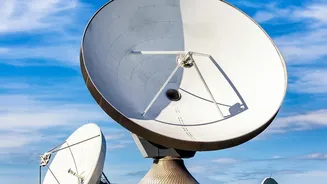
The telescopes used for this work are not like typical astronomical telescopes. Known as Imaging Atmospheric Cherenkov Telescopes (IACTs), they use huge, segmented mirrors to collect the faint Cherenkov light and focus it onto highly sensitive cameras made of photomultiplier tubes. In this technique, the Earth's atmosphere isn't an obstacle to be overcome; it's an essential part of the detector system. The air shower itself acts as the signal generator. By using multiple telescopes in an array, scientists can view the same shower from different angles, a technique called stereoscopy. This allows them to reconstruct the shower's trajectory and pinpoint the origin of the original cosmic ray in the sky with impressive precision.
The Challenge of a Changing Sky
Because the atmosphere is a critical component of the instrument, any changes in it can affect the measurements. The atmosphere is a dynamic, chaotic environment. Its temperature, pressure, and density are in constant flux. These changes alter how the Cherenkov light travels and how the air shower develops. For instance, a warmer, expanded atmosphere can change the number of particles that decay and produce detectable signals. To get a clear and accurate picture, scientists can't just take the data at face value; they must account for the ever-changing state of the sky. This is where continuous calibration becomes non-negotiable.
Why Constant Vigilance Is Key
Calibration is the process of ensuring an instrument provides accurate and reliable measurements. For Cherenkov telescopes, this means constantly monitoring both the instrument's performance and the atmospheric conditions. A variety of methods are used. Lasers are sometimes fired into the sky to create an artificial light source, allowing engineers to check the mirror alignment and camera focus. Observing known, stable light sources like specific stars also helps. Another ingenious method uses the cosmic rays themselves: muons, a type of particle from air showers, produce distinct ring-shaped images that can be used to calibrate the camera's light collection efficiency. This continuous adjustment ensures that a change in the signal is due to an astrophysical event, not a change in the weather or a detector quirk. Without it, the faint flash of a distant gamma-ray burst could be lost in the noise.