




The Solar System’s Strangest Clock
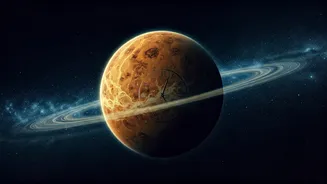
On Earth, our concepts of a day and a year are fundamental. A day is one rotation of our planet, and a year is one trip around the Sun. It’s a simple, reliable rhythm. Venus, however, plays by a completely different set of rules. A single rotation of Venus on its
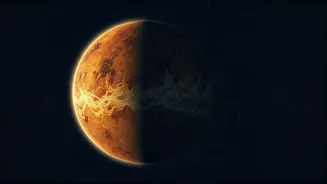
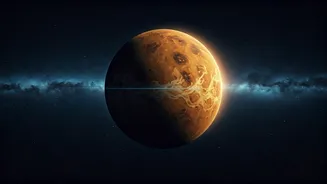
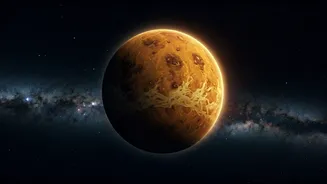
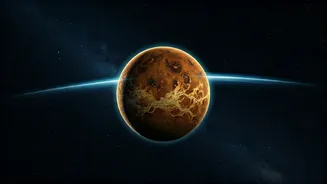
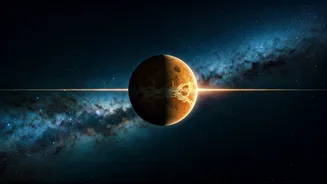
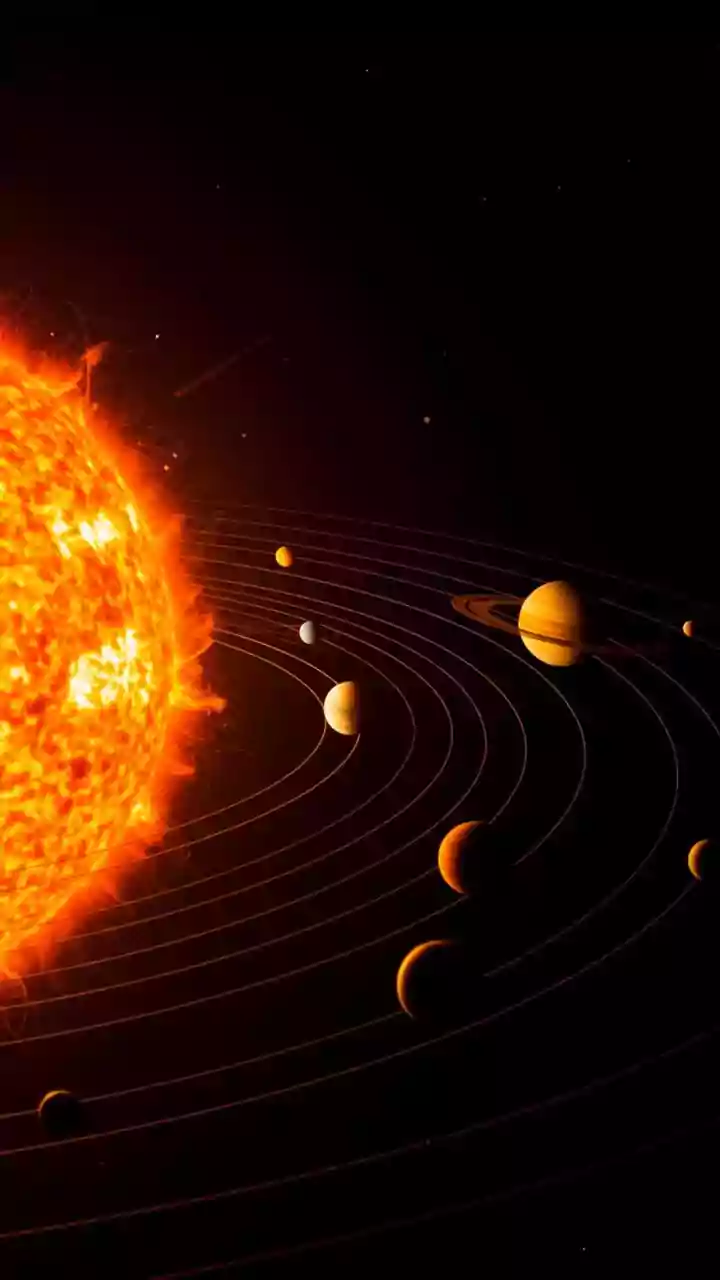
axis—its sidereal day—takes approximately 243 Earth days to complete. In stark contrast, its journey around the Sun—its year—takes only about 225 Earth days. This means that on Venus, a day is longer than a year. If you could stand on its surface, you would complete a full orbit around the Sun before the planet itself has spun around just once. It’s a bizarre cosmic anomaly that makes Venus one of the most peculiar worlds in our solar system. Adding to the strangeness, Venus rotates 'backwards' compared to Earth and most other planets, a phenomenon known as retrograde rotation. This means the Sun rises in the west and sets in the east.
Untangling a Venusian Day
To fully grasp the weirdness, it’s important to distinguish between two types of day. The 243-day figure is a 'sidereal day,' measured against the distant stars. But what about a 'solar day'—the time from one sunrise to the next? Because Venus rotates backwards while orbiting the Sun, these two motions work against each other in a unique way. The result is a solar day that is significantly shorter than its sidereal day, clocking in at around 117 Earth days. So, while the planet itself takes 243 days to spin once, an observer on the surface would experience a sunrise every 117 days. That’s still an incredibly long time to wait for morning, with nearly two months of daylight followed by two months of darkness. This sluggish, contrary rotation is a key piece of the puzzle in understanding Venus’s extreme environment, including its runaway greenhouse effect and crushing atmosphere.
How Modern Observers Pitch In
While the slow rotation of Venus was first confirmed by radar in the 1960s, the headline’s mention of 'astrophotographers' points to a more recent, exciting development in planetary science: citizen science. Professional space missions like Japan’s Akatsuki probe are incredibly valuable, but they can't watch the planet all the time. This is where a global network of dedicated amateur astrophotographers comes in. By using sophisticated cameras and telescopes from their backyards, these enthusiasts capture high-resolution images of Venus's cloud tops. These images are crucial for tracking atmospheric features and wind speeds. A 2020 study, for instance, used data collected by amateur astronomers from 2008 to 2017 to study the planet’s 'super-rotation,' where the atmosphere whips around the planet in just four Earth days. By documenting the movement of these clouds, astrophotographers provide a continuous stream of data that helps scientists model and understand the complex relationship between the planet’s thick atmosphere and its slow, solid-body rotation.
Why the Slow, Backward Spin?
The ultimate question is why Venus spins this way. The truth is, scientists don't have a definitive answer, but there are two leading theories. The first involves a colossal, planet-shattering impact early in the solar system's history. According to this model, a massive object could have slammed into a young Venus, not only slowing its rotation to a near-standstill but also knocking it over, effectively reversing its spin. The second major theory suggests a more gradual process involving Venus's incredibly thick atmosphere. Over billions of years, the gravitational pull of the Sun could have created strong atmospheric tides. The friction between this churning, heavy atmosphere and the solid planet beneath could have acted as a powerful brake, slowing down its rotation and eventually causing it to spin in reverse. It’s possible that a combination of these and other factors contributed to the planet’s current state, a mystery that future missions hope to solve.