

The Constant Battle in Low-Earth Orbit
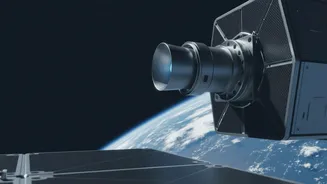
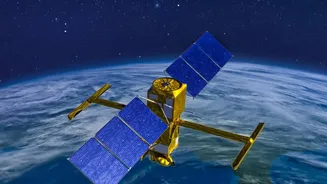
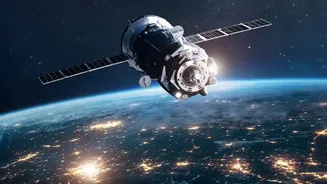
Low-Earth orbit (LEO) and very low-Earth orbit (VLEO) are bustling regions of space, critical for everything from high-speed internet to detailed Earth observation. However, operating at altitudes below about 400 kilometres comes with a persistent challenge:
atmospheric drag. While the atmosphere is incredibly thin at these heights, there are still enough air molecules to create friction against a satellite moving at over 7 kilometres per second. This drag acts like a brake, causing the satellite's orbit to decay. Without a way to counteract this force, the satellite will eventually fall back to Earth and burn up. This fundamental limitation dictates the operational lifetime of many valuable assets in space.
The Conventional Solution: A Finite Fuel Tank
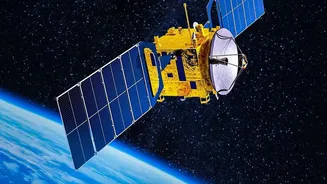
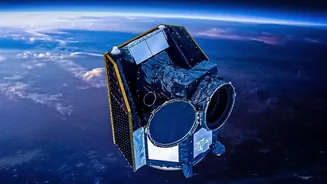
For decades, the standard solution to orbital decay has been to equip satellites with their own propulsion systems and a finite supply of onboard propellant, like xenon gas. When the satellite's orbit begins to drop, it fires its thrusters to provide a boost, pushing it back up to its operational altitude. The European Space Agency's GOCE gravity-mapping satellite, for instance, used an electric thruster to continuously compensate for air drag, allowing it to operate as low as 250 kilometres for over four years. But once its 40 kilograms of xenon ran out, the mission was over. This reliance on stored fuel means every mission has a built-in expiration date, limiting its long-term value and effectiveness.
A Revolutionary Idea: Breathing the Atmosphere
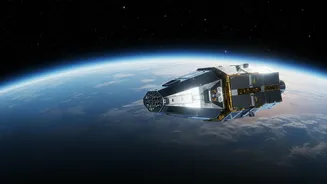
What if, instead of fighting the atmosphere, a satellite could use it as a resource? This is the game-changing concept behind Air-Breathing Electric Propulsion (ABEP), also known as Atmosphere-Breathing Electric Propulsion. This technology is designed to collect the sparse atmospheric particles responsible for drag and use them as an infinite source of propellant. Instead of carrying heavy fuel tanks, an ABEP-equipped satellite scoops up the residual air—mostly nitrogen and oxygen—and feeds it into an electric thruster. This turns the very element that threatens the mission into the fuel that sustains it, enabling satellites to stay in orbit for years longer than their conventional counterparts.
How Air-Breathing Propulsion Works
The process is elegant in its core concept. First, a specially designed passive intake at the front of the satellite collects the incoming air molecules as the spacecraft speeds through its orbit. The design of this collector is crucial, as it must efficiently capture and compress the molecules without them simply bouncing off. Once collected, these atmospheric gases are channelled into a thruster. There, using power generated by solar panels, the gas is ionized—its atoms are given an electric charge. These newly created ions can then be accelerated by electric and magnetic fields and expelled at high velocity, generating a continuous, low-level thrust that perfectly counteracts the atmospheric drag. In 2018, the European Space Agency (ESA) and its partners successfully demonstrated a working prototype on the ground, proving the concept is no longer just a theory.
The 'Mission-Ready' Advantage
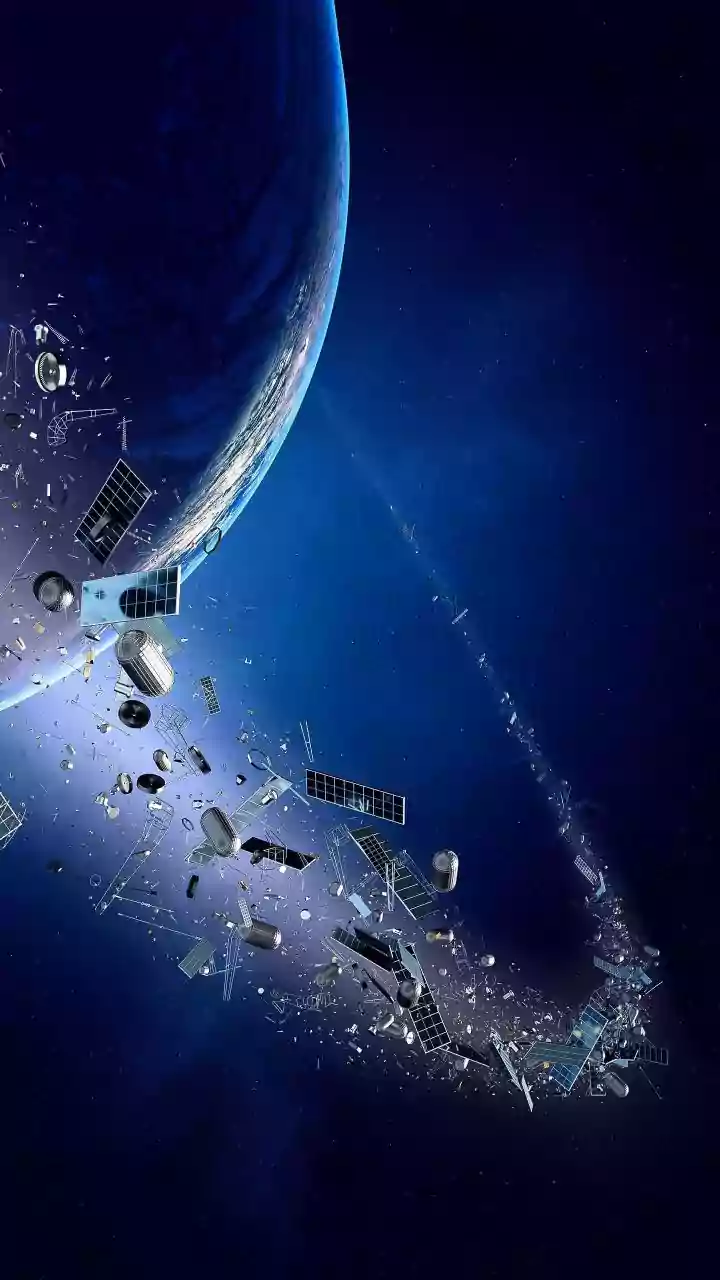
The ability to generate thrust without onboard propellant is what keeps these satellites perpetually mission-ready. It unlocks several key advantages. First and foremost is mission longevity; satellites are no longer limited by their fuel supply, potentially operating for as long as their electronic components last. This also makes missions more sustainable, as satellites can naturally and safely deorbit at their end of life by simply turning off the thruster, reducing the risk of creating more space debris. Furthermore, it opens up the possibility of sustained operations in very low-Earth orbits (between 120 and 250 km), an altitude range that was previously impractical for long-term missions. Flying closer to Earth allows for higher-resolution imaging for observation satellites and lower latency for communication networks.
The Future of Sustainable Orbits
While the technology is still maturing, with challenges remaining in optimizing intake efficiency and ensuring material durability against corrosive atomic oxygen, ABEP is poised to redefine satellite operations. Research groups and space agencies are actively developing and testing these systems, transitioning from theory to demonstration. This technology could not only transform missions around Earth but also be adapted for other planets with atmospheres, such as using the carbon dioxide on Mars for propulsion. By eliminating the reliance on propellant, air-breathing electric propulsion offers a path toward more capable, cost-effective, and environmentally responsible use of space, ensuring that the next generation of satellites can remain on station and ready for duty indefinitely.