





Meet the Habitable Worlds Observatory
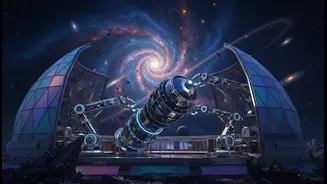
NASA's next flagship mission, slated for the 2040s, is the Habitable Worlds Observatory (HWO). Its primary goal is as profound as it gets: to directly image Earth-like planets around Sun-like stars and scan their atmospheres for signs of life. To do this,
HWO will need unprecedented stability and precision, capable of blocking a star's light by a factor of 10 billion to see the faint glow of a planet next to it. But the most significant part of its design isn't just its powerful optics; it's the plan to keep it working. Recent announcements confirm that HWO is being engineered from the ground up for in-space servicing, assembly, and maintenance.
The Billion-Dollar Bet on Repairs
Serviceability means a spacecraft is designed to be visited, repaired, refueled, or upgraded. Think of it as the difference between a modern car, with replaceable parts, and a disposable camera. For a multi-billion dollar asset operating 1.5 million kilometers from Earth, this is a game-changer. The decision represents a major strategic shift away from the philosophy behind the James Webb Space Telescope (JWST). While an engineering marvel, JWST was a high-stakes gamble. With over 300 single points of failure, it had to deploy perfectly, with no possibility of a repair mission. Its complexity and extreme distance made servicing unfeasible.
A Lesson Learned from Hubble
The value of serviceability was proven by the Hubble Space Telescope. Launched in 1990 with a flawed mirror, Hubble would have been a catastrophic failure without a repair mission. Subsequent servicing missions by Space Shuttle astronauts not only fixed the initial problem but repeatedly upgraded its instruments, effectively transforming it into a new, more powerful telescope multiple times over. These upgrades dramatically extended its life and scientific returns, making it one of the most productive scientific instruments in history. Without the ability to service it, Hubble's view of the cosmos would have remained blurry and its lifespan much shorter.
Robots, Not Astronauts
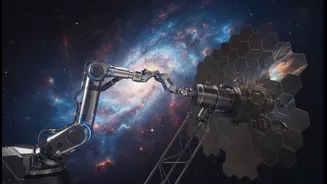
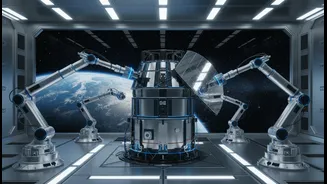
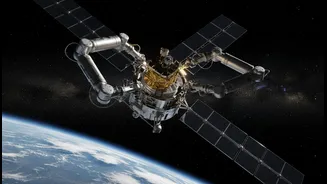
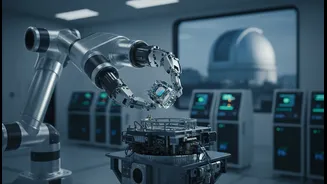
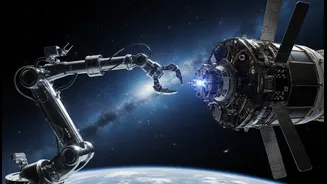
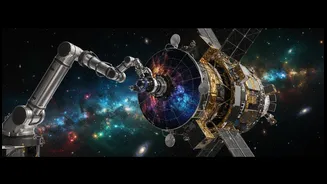
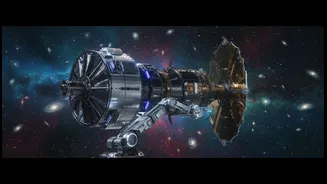
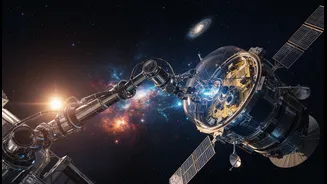
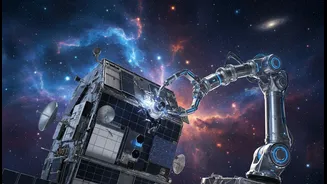
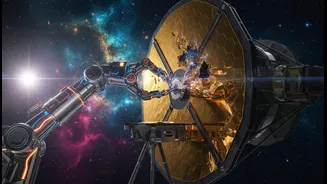
Unlike Hubble, which was in low-Earth orbit, HWO will operate at the distant Sun-Earth Lagrange point 2 (L2), the same region as JWST. This location is ideal for astronomy but is currently beyond the reach of crewed missions for repairs. The solution is robotics. NASA envisions a future where autonomous or remotely operated spacecraft can dock with HWO to perform complex tasks. These robotic servicers could swap out old scientific instruments for new, more advanced ones, fix failing components, and even potentially assemble parts of the telescope in orbit if it's too large to launch in one piece. This modular design is central to the entire concept, ensuring components are accessible to a robotic mechanic.
A Sustainable Future for Discovery
Building serviceability into HWO from day one does more than just protect an expensive investment; it creates a sustainable platform for decades of science. It allows the observatory to evolve, incorporating new technologies as they are developed rather than being frozen with the technology of its launch era. This approach also mitigates risk. If a critical component fails after launch, it's no longer a mission-ending disaster. Furthermore, by mandating a serviceable design, NASA is helping to drive the commercial industry for in-space servicing, assembly, and manufacturing, creating a new ecosystem for maintaining assets in deep space. This makes the Habitable Worlds Observatory not just a tool for finding other Earths, but a blueprint for a more resilient and adaptable future of space exploration.