


What Exactly Is Aphelion?
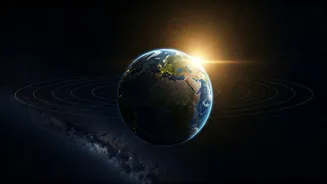
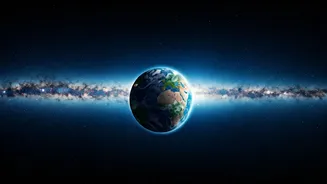
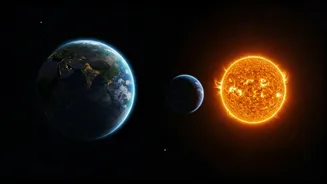
In simple terms, aphelion is the point in Earth's orbit where it is farthest from the Sun. Many people assume our planet orbits the Sun in a perfect circle, but that's not quite right. The orbit is actually a slight ellipse, like a gently squashed circle.
Because of this elliptical path, there is a point every year when Earth is closest to the Sun (called perihelion, which happens in early January) and a point when it is farthest away (aphelion). The words come from ancient Greek, where 'apo' means far and 'helios' means Sun. This year, aphelion occurs on July 6, 2026. At that moment, our planet will be roughly 152.1 million kilometres from the Sun.
The Summer Paradox: Tilt, Not Distance
The most common question about aphelion is a logical one: if we are millions of kilometres farther from the Sun, shouldn't it be colder? The answer lies not in our distance, but in our planet's tilt. Earth is tilted on its axis by about 23.5 degrees. It is this tilt that causes the seasons. During July, the Northern Hemisphere, where India is located, is tilted towards the Sun. This means the Sun's rays hit our part of the world more directly and for longer periods each day, leading to the heat of summer. Conversely, during our winter in January, the Northern Hemisphere is tilted away from the Sun. This happens even though the entire planet is actually closer to the Sun at perihelion.
Does Aphelion Have Any Effect At All?
While the axial tilt is the main character in the story of our seasons, aphelion does play a minor role. At aphelion, the Earth receives about 7% less intense sunlight than it does at perihelion. However, this effect is largely cancelled out by other factors. Interestingly, the entire planet's average temperature is slightly warmer during aphelion. This is because the Northern Hemisphere, which has more landmass than the Southern Hemisphere, is tilted toward the Sun. Land heats up more easily than water, raising the planet's overall average temperature slightly. Another subtle effect is on the length of the seasons. According to Kepler's laws of planetary motion, a planet moves slower when it is farther from the sun. This means our journey through the summer months is a little slower, making summer in the Northern Hemisphere a few days longer than winter.
Can You See It Happen?
Aphelion is not a visual spectacle like a solar eclipse or a meteor shower. It is simply a specific point in our planet's invisible orbit around the Sun. You will not feel a jolt or see anything change in the sky at the exact moment it occurs. While the Sun is technically smaller in the sky at aphelion compared to perihelion, the difference is so small that it is completely unnoticeable to the naked eye. You would need a telescope with special filters to even detect the subtle change in the Sun's apparent size. So, there is nothing specific to watch for, but it's a wonderful opportunity to think about the complex and elegant mechanics of our solar system that work silently in the background of our daily lives.