



The Challenge: A Firefly by a Spotlight
Imagine trying to spot a tiny firefly buzzing next to a colossal, blindingly bright spotlight. That's the challenge astronomers face when trying to directly image an Earth-like exoplanet. The host star is billions of times brighter than the faint light reflected
by its orbiting planet, completely washing it out. Furthermore, these planets are so far away and so close to their star that distinguishing them is like trying to resolve two separate pinpricks of light from miles away. Current methods, like observing the dip in starlight as a planet passes in front (the transit method) or measuring the star's wobble, are indirect. They tell us a planet is there and can reveal its size and mass, but they don't give us a picture.
Enter SHAPE: A New Hope for Direct Imaging
SHAPE, which stands for Spectro-Polarimetric High-contrast Exoplanet REsearch, is an instrument designed to overcome these exact problems. Though currently an instrument on the Very Large Telescope in Chile, the name represents a technological approach that future space missions could adopt. It’s not just about taking a simple picture. SHAPE's goal is to directly capture the light from a planet and analyze it in unprecedented detail. To do this, it combines several cutting-edge technologies. The first is an advanced coronagraph, which acts like a sophisticated sunshield inside the telescope, precisely blocking the overwhelming glare from the host star. This dimming of the star is the critical first step to revealing the much fainter planet nearby.
The Secret Weapon: Polarized Light
Here's where SHAPE gets really clever. Light from a star is typically unpolarized, meaning its waves oscillate in random directions. However, when that starlight reflects off a planet’s atmosphere or surface, it becomes polarized—the light waves start to align in a specific direction. SHAPE is designed to be extremely sensitive to this polarized light. By filtering for it, the instrument can more effectively separate the faint, reflected light of the planet from the remaining scattered light of its star. It’s like having special sunglasses that can see the firefly while filtering out the haze from the spotlight. This technique, called polarimetry, is key to not just detecting the planet but also learning about its characteristics.
Sketching an Alien World
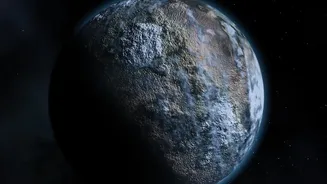
By analyzing the polarized light, scientists could begin to piece together a rough map of an exoplanet’s surface. For example, light reflecting off an ocean would have a different polarization signature than light reflecting off a continent or a cloud. By observing these subtle changes as the planet rotates, astronomers could infer the presence of oceans, landmasses, and weather patterns. The instrument would also perform spectroscopy, breaking down the planet’s light into its constituent colors. This can reveal the chemical composition of its atmosphere, allowing scientists to search for biosignatures—gases like oxygen or methane that could indicate the presence of life. This would transform exoplanets from simple data points into tangible worlds.
The Path Forward
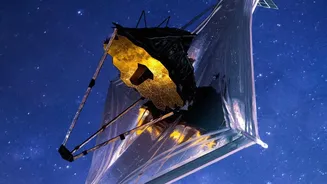
The SHAPE instrument currently operating is a ground-based system on the VLT, which has already proven its incredible potential by capturing stunning images of dust disks where planets form. However, to truly characterize an Earth-like planet, a similar but even more powerful instrument would likely need to be in space, free from the distortions of Earth's atmosphere. Concepts for such space-based missions are being studied by agencies like NASA. These future observatories would build on the lessons learned from both SHAPE and the James Webb Space Telescope to create a dedicated planet-finder. While a funded mission is still on the horizon, the SHAPE concept provides a clear and promising roadmap for the future of exoplanet exploration.