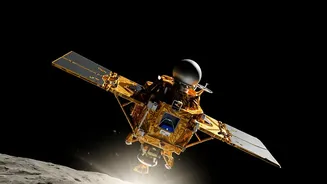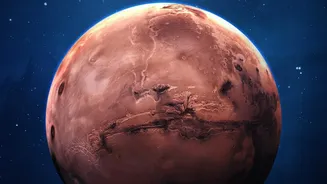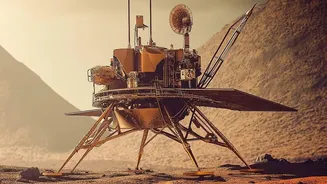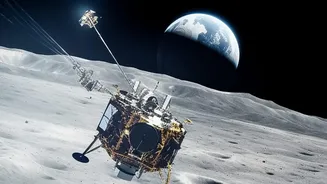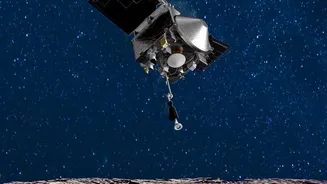



Japan's ambitious Martian Moons eXploration (MMX) mission is undertaking one of the most complex sample-return quests ever attempted: to land on Mars' moon Phobos, collect surface material, and bring it back to Earth. It's a high-stakes journey.
What is Phobos?
Phobos
is the larger and innermost of Mars' two small moons, the other being Deimos. Discovered in 1877, it's an irregularly shaped, potato-like body roughly 27 kilometres across at its widest point. Its surface is one of the least reflective in the solar system, dominated by a massive impact crater named Stickney, which is so large it nearly shattered the moon. Phobos orbits Mars much faster than the planet rotates, completing a circuit in just over seven and a half hours. This means that from the Martian surface, it appears to rise in the west and set in the east. It’s also on a collision course with its parent planet, drawing closer by about 1.8 metres every century and is expected to either crash into Mars or be torn apart into a ring in about 50 million years.
The Central Mystery: Captured Asteroid or Giant Impact?
The primary scientific driver for visiting Phobos is to solve the mystery of its origin. There are two main competing theories. The first is that Phobos and Deimos are captured asteroids, wanderers from the asteroid belt that were snagged by Mars' gravity long ago. Their dark, carbon-rich surface appears similar to certain types of asteroids, which supports this idea. The second theory posits that a massive object once collided with Mars, sending a huge amount of debris into orbit that eventually clumped together to form the moons, much like how Earth's Moon is thought to have formed. The moons' stable, circular orbits are more consistent with this giant impact hypothesis. By analyzing a physical sample, scientists can determine its composition and age, which should definitively reveal whether Phobos is a piece of the early solar system or a piece of Mars itself.
The MMX Mission: A Daring Plan
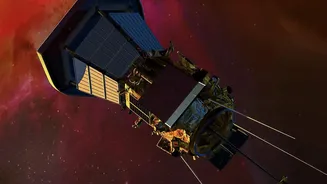
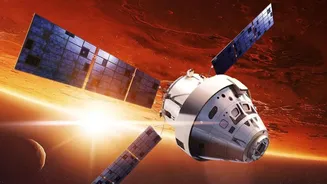
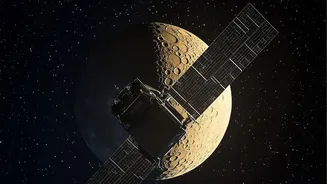
The Martian Moons eXploration (MMX) mission, led by the Japan Aerospace Exploration Agency (JAXA) with international partners including NASA and European agencies, launched in October 2026. The spacecraft is scheduled to arrive in orbit around Mars in August 2027. From there, it will spend about a year carefully observing both Phobos and Deimos before attempting its most critical phase. In 2029, the plan is for the main spacecraft to land on Phobos, collect at least 10 grams of surface material, and then take off again. Before the main sampling, MMX will deploy a small French-German rover named Idefix to explore the surface for about three months, helping to provide ground truth and context for the returned samples. After its work at Phobos is done, the spacecraft will perform several flybys of Deimos before beginning its journey home. The capsule containing the precious cargo is scheduled to land in Australia in 2031.
The Challenge of Landing on 'Fear'
Landing on Phobos—whose name means 'fear'—is a monumental challenge, and previous missions aimed at the moon have failed. The moon's gravity is less than onendredth of Earth's, which means a traditional 'landing' is more like a delicate docking procedure. The spacecraft can’t simply land; it has to gently touch down and anchor itself to avoid bouncing right back into space. This microgravity environment also makes the surface dust a significant hazard. Furthermore, Phobos is deep within Mars' own gravity well, orbiting just 6,000 kilometres above the planet's surface, complicating the orbital mechanics of the approach and landing. The MMX team has developed specialized technology to handle these extreme conditions for what will be the first ever landing on and sample return from a Martian moon.
What's at Stake for Science?
The samples from Phobos could be a scientific treasure trove. If Phobos is a captured asteroid, its material would offer a pristine look at the building blocks of the early solar system, including the potential delivery of water and organic compounds to the inner planets. If it formed from a giant impact on Mars, the sample would be a time capsule from ancient Mars, providing insight into the planet's early geology and evolution without the immense difficulty and cost of a sample return mission from the Martian surface itself. Either outcome will provide groundbreaking information about how planets and their moons form and evolve, helping us piece together the history of our own cosmic neighbourhood.