







Why Just Five Minutes Matters
The idea that you need a full hour at the gym to see results is quickly becoming outdated. Health experts are increasingly promoting the concept of 'exercise snacking'—short, manageable bursts of activity spread throughout the day. Research shows that these
mini-workouts can offer benefits comparable to a single, longer session. Accumulating activity in five or ten-minute chunks makes it easier to meet weekly fitness goals and, more importantly, to build a sustainable habit. These brief sessions can improve your mood, boost energy, enhance cardiovascular health, and even help regulate blood sugar. The key isn't duration, but consistency. Making time for just five minutes of focused movement every day is a powerful commitment to your long-term well-being.
The Five-Minute, Small-Space Circuit
This routine is designed as a circuit. Perform each of the following five exercises for 45 seconds, followed by 15 seconds of rest before moving to the next. This totals five minutes of continuous, effective work. All you need is a small patch of floor, about 6x6 feet, making it perfect for any Indian home, from a compact city apartment to a busy joint family household. No special equipment is needed, just your own body weight. A yoga mat can be helpful for comfort, but isn't essential. Remember to listen to your body and move at a pace that feels right for you.
Move 1: Marching High Knees
Let's start by waking up the body and getting the blood flowing. Stand tall with your feet hip-width apart and your core engaged. Begin marching in place, but with an emphasis on lifting your knees high, aiming for your waist level. As you lift your right knee, bring your left arm forward, and vice-versa, in a coordinated rhythm. This isn't about speed, but about controlled, deliberate movement. High knees serve as an excellent dynamic warm-up, activating your core, hip flexors, and improving coordination while gently elevating your heart rate without the high impact of running.
Move 2: Bodyweight Squats
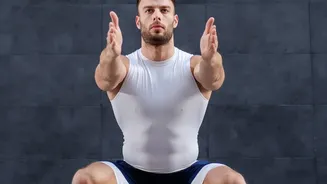
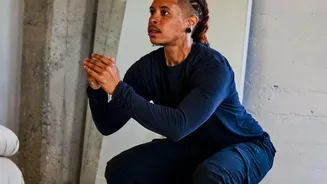
Squats are a foundational movement that strengthens your entire lower body, including your glutes, quadriceps, and hamstrings. Stand with your feet slightly wider than your shoulders, toes pointing slightly outward. Keeping your chest up and your back straight, lower your hips as if you're sitting back into a chair. Go as low as you comfortably can, aiming to get your thighs parallel to the floor, then press through your heels to return to the starting position. This powerful exercise builds functional strength that helps with everyday activities, from lifting groceries to playing with children.
Move 3: Incline Push-Ups
The push-up is a fantastic upper-body and core exercise, but the floor version can be challenging for beginners. An incline push-up is the perfect modification. Use a sturdy wall, a kitchen counter, or the arm of a sofa. Place your hands on the surface, slightly wider than your shoulders, and step your feet back so your body forms a straight line from head to heels. Bend your elbows to lower your chest towards the surface, then push back powerfully to the start. The higher the incline, the easier the exercise, allowing you to build strength safely.
Move 4: Plank
No exercise targets the core quite like the plank. It strengthens your abdominals, back, and shoulders all at once. Get into position by placing your forearms on the floor with your elbows directly under your shoulders. Extend your legs back, resting on your toes. Your body should form a straight, rigid line from your head to your heels. Avoid letting your hips sag or rise too high. Engage your core by pulling your belly button towards your spine and hold this position. The plank builds immense stability and endurance without a single movement.
Move 5: Jumping Jacks
To finish the circuit with a cardiovascular boost, we turn to the classic jumping jack. This full-body move elevates your heart rate, burns calories, and improves coordination. Stand with your feet together and your arms at your sides. In one fluid motion, jump your feet out to the sides while raising your arms overhead. Immediately jump back to the starting position. Find a steady rhythm that you can maintain for the full 45 seconds. If jumping is too high-impact, you can perform a modified, low-impact version by stepping one foot out to the side at a time while still moving your arms.