



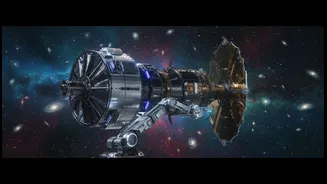


The Golden Age of Astronaut Repair
For decades, the image of space repair was an astronaut on a spacewalk. The Hubble Space Telescope, a revolutionary observatory, owes its long and productive life to five separate servicing missions performed by Space Shuttle crews between 1993 and 2009.
Astronauts physically replaced instruments, fixed faulty components, and upgraded its capabilities, turning a potentially short-lived mission into a multi-decade scientific powerhouse. These missions were heroic, complex, and hugely successful. They established a paradigm: with human ingenuity, we could fix our most precious assets in orbit. But that paradigm was entirely dependent on a spacecraft, the Space Shuttle, that could reach Hubble's orbit just a few hundred miles up and a telescope that was specifically designed from the ground up to be serviced by human hands.
A Million Miles from a Wrench
Today's flagship observatories, like the James Webb Space Telescope (JWST) and the upcoming Nancy Grace Roman Space Telescope, are in a completely different league. To shield them from Earth's heat and light, they are positioned at a gravitationally stable location known as Lagrange Point 2 (L2), roughly 1.5 million kilometres away. No human-rated spacecraft currently exists that can travel that far. Furthermore, these telescopes were not designed for hands-on repairs. Their intricate, fragile components, like Webb's tennis-court-sized sunshield, were never intended to be handled by a bulky spacesuit glove. The enormous cost and complexity of these observatories make them single-point-of-failure assets; a simple mechanical issue could prematurely end a multi-billion dollar mission.
Enter the Robotic Mechanic
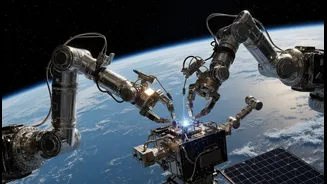
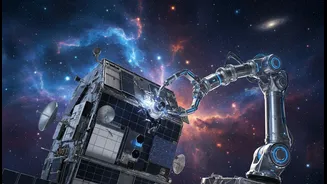
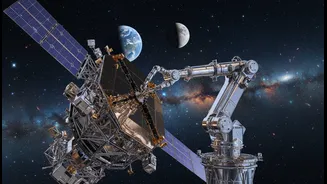
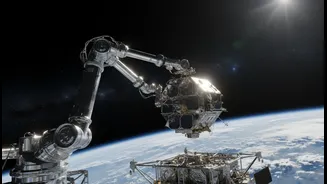
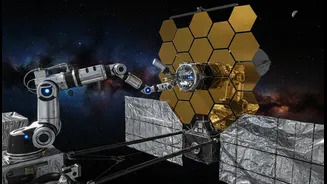
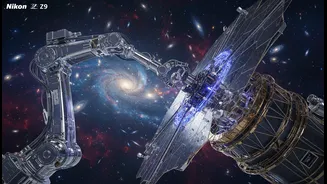
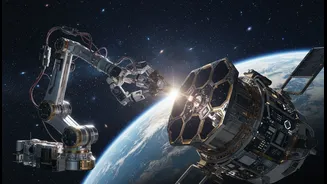
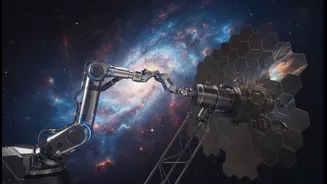
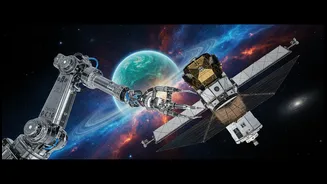
The solution is not to send humans, but to send robots. The field of on-orbit servicing, assembly, and manufacturing (OSAM) is emerging as one of the most critical new capabilities for a sustainable future in space. This involves developing sophisticated robotic spacecraft that can autonomously rendezvous with a satellite, dock with it, and perform complex tasks. These tasks could range from refueling and orbital re-boosting to component repair and even full-scale upgrades. Just recently, in a first-of-its-kind mission, NASA commissioned the startup Katalyst Space Technologies to launch a robotic servicer to rescue the aging Swift telescope, whose orbit was decaying. The successful launch of this mission in early July 2026 represents a landmark shift toward using commercial partners for rapid, robotic solutions to extend the life of valuable assets.
A Commercially Driven Future
While NASA has long been a champion of this technology, the path forward has proven to be complex. The agency's ambitious OSAM-1 mission, which aimed to refuel a satellite not designed for servicing, was cancelled in 2024 due to persistent cost and schedule challenges. This cancellation, however, did not signal the end of the dream. Instead, it highlighted a pivot towards a commercially-led market. Companies like Northrop Grumman, with its successful Mission Extension Vehicle (MEV) that has already docked with and extended the life of commercial satellites, are proving the business case. Other players like Astroscale, Maxar, and Orbit Fab are developing everything from debris removal services to in-space refueling depots, creating the building blocks of a new orbital economy. NASA's focus is now shifting to enabling this commercial market, as seen with the Swift rescue mission and plans to make future flagships like the Habitable Worlds Observatory robotically serviceable from the start.
More Than Just a Repair
The implications of reliable robotic servicing go far beyond just fixing what's broken. It fundamentally changes the philosophy of space exploration from disposable to sustainable. Imagine being able to upgrade a telescope’s camera with a next-generation sensor a decade after launch, or assembling a massive new observatory in orbit that would be too large to launch from Earth in one piece. This capability transforms satellites from finite assets into enduring platforms for science and commerce. It allows for more ambitious designs, reduces the long-term cost of space operations, and helps mitigate the growing problem of space debris by allowing for refueling and controlled de-orbiting of defunct satellites. The development of standardized docking plates and refueling ports is a key step in making this a routine reality.