



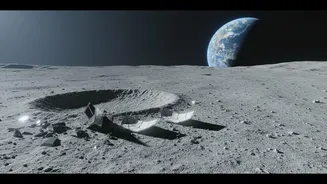

An Accidental Experiment
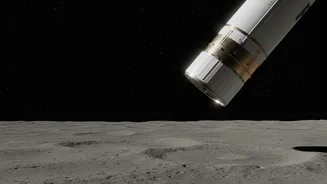
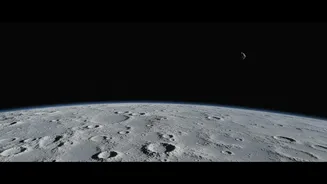
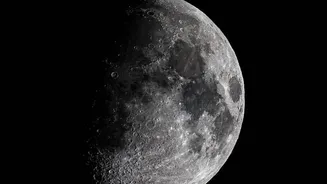
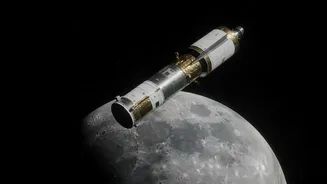
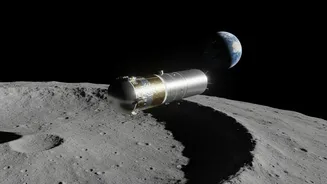
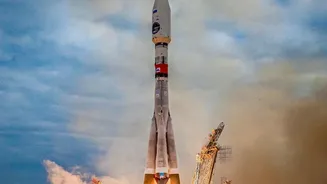
On August 5, 2026, a spent upper stage from a SpaceX Falcon 9 rocket is expected to crash into the Moon. The rocket part, left over from a 2025 mission to deploy a lunar lander, has been in an unpredictable orbit, slowly nudged by gravitational forces
and the gentle pressure of sunlight. Astronomers have been tracking its trajectory, forecasting an impact that, while not dangerous, presents a valuable chance for observation. Impacts like these kick up a plume of lunar soil, or regolith, giving scientists a brief window to analyze material from beneath the surface. However, unlike a carefully planned mission, an accidental collision is a messy affair, full of unknowns that complicate the science.
The Challenge of the Unknown Impactor
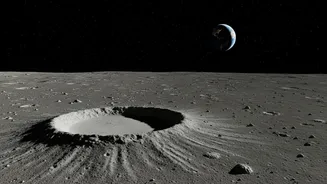
One of the biggest hurdles in studying an unplanned crash is not knowing the precise nature of the object hitting the Moon. A prime example was a mysterious 2022 lunar impact. Initially thought to be a SpaceX booster, it was later identified as likely being a Chinese Long March rocket stage. That object left a strange double crater, suggesting it had a large, uncatalogued mass at both ends, a feature not seen in previous impacts from Apollo-era rockets. This uncertainty is a major problem for scientists. To understand what the impact plume is made of, you first need to subtract the materials from the impactor itself—its metals, paints, and any leftover fuel. Without a complete manifest of the rocket stage's composition, it's difficult to say with certainty whether the elements detected in the plume are from the Moon or from the rocket.
A Tale of Two Crashes: Planned vs. Unplanned
The limits of an accidental crash are best understood when compared to a deliberate one, like NASA’s Lunar Crater Observation and Sensing Satellite (LCROSS) mission in 2009. The LCROSS mission was a masterclass in controlled destruction. NASA purposefully slammed a Centaur rocket stage into a permanently shadowed crater near the Moon's south pole. Critically, they knew the impactor's exact mass, velocity, and composition. A second, 'shepherding' spacecraft flew through the resulting debris plume just four minutes later, equipped with instruments specifically designed to analyze it. This allowed for a clear detection of water ice and other useful compounds in the lunar soil. An unplanned crash lacks this preparation. Telescopes on Earth and in orbit can be pointed at the impact site, but they weren't designed as a dedicated follow-along mission and can't fly through the plume for direct sampling.
Data We Can and Cannot Get
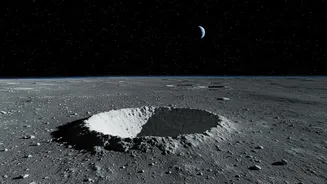
Despite the limitations, there is still valuable science to be done. The upcoming Falcon 9 impact will be used to refine techniques for tracking objects in deep space. Observing the plume's behaviour helps improve models of how ejecta spreads in the Moon's low gravity and near-vacuum, which is crucial for the safety of future lunar bases and equipment. The size and shape of the resulting crater, which NASA's Lunar Reconnaissance Orbiter can image later, will also provide data to compare with known impactors. However, the most sought-after data—a definitive chemical analysis of pristine subsurface material—remains difficult to obtain. We can't place instruments at the site beforehand, and remote observation from hundreds of thousands of kilometers away is no substitute for getting up close. The event highlights the growing concern over space debris and the need for better regulation as more missions head to the Moon.