






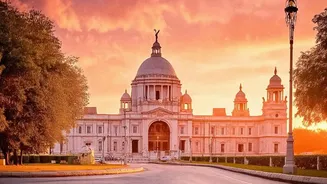
Victoria Memorial: The White Marble Marvel
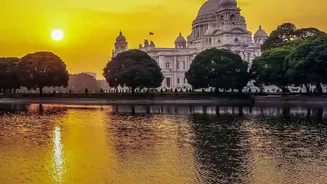
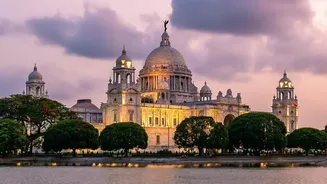
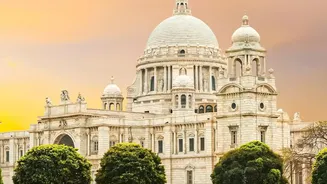
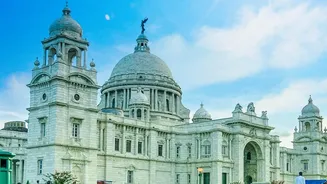
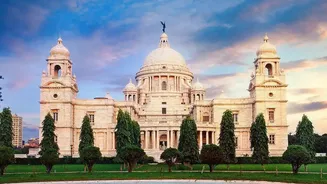
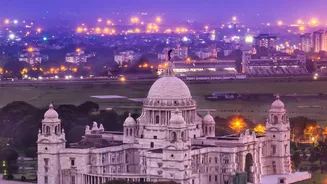
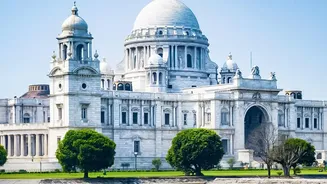
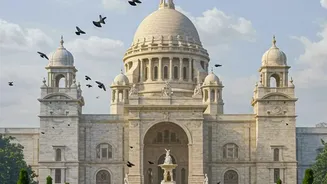
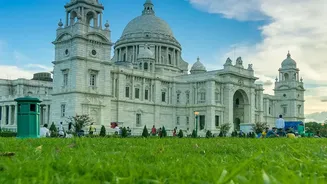
Undoubtedly Kolkata's most iconic landmark, the Victoria Memorial is a breathtaking tribute to Queen Victoria. Conceived by Lord Curzon after her death, the monument was built between 1906 and 1921 using the same Makrana marble as the Taj Mahal. Its design
is a masterful blend of British and Mughal architectural styles, often described as Indo-Saracenic. The vast structure is topped by a large central dome, upon which stands the bronze 'Angel of Victory'. Today, it functions as a museum set within 64 acres of lush gardens, housing 25 galleries filled with paintings, sculptures, and manuscripts from the British period. It serves not just as a memorial but as a vibrant cultural space in the heart of the city.
Writers' Building: The Seat of Power
The striking red facade of the Writers' Building, or Mahakaran, has been a silent witness to centuries of political history. Located in B.B.D. Bagh (formerly Dalhousie Square), this 150-metre-long structure was originally designed by Thomas Lyon in 1777 to house the junior clerks, or 'writers', of the East India Company. Over the years, it evolved from a simple office into the administrative headquarters for the Bengal Presidency and, after independence, the Government of West Bengal. The building is also a significant site in India's freedom struggle, most notably as the location where revolutionaries Benoy, Badal, and Dinesh attacked a British official in 1930, leading to the area being renamed in their honour.
St. Paul's Cathedral: A Gothic Masterpiece
Recognised as the first Anglican cathedral in Asia, St. Paul's Cathedral is a magnificent example of Gothic Revival architecture adapted for the Indian climate, a style known as Indo-Gothic. The cornerstone was laid in 1839 to accommodate Kolkata's growing European community, and the structure was completed in 1847. Designed by Major William Nairn Forbes, its soaring spire, pointed arches, and large stained-glass windows are standout features. Though the original spire was damaged in earthquakes, it was reconstructed. Inside, the cathedral can hold up to a thousand people and contains beautiful frescoes and memorials, including a west window designed by Sir Edward Burne-Jones.
General Post Office: A Dome of Distinction
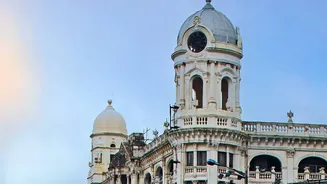
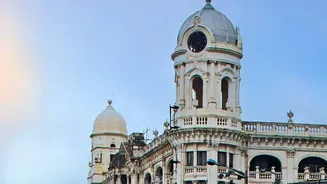
The Kolkata General Post Office (GPO), with its high domed roof and towering Ionic-Corinthian pillars, is one of the city's most prominent colonial landmarks. Designed by Walter B. Grenville, the building was constructed between 1864 and 1868 on the site of the first Fort William, which was destroyed in 1756. A brass plate on the eastern staircase marks a remnant of the old fort. Besides being the central post office for West Bengal, the GPO also houses a postal museum that showcases a fascinating collection of stamps and artefacts. A grand clock, imported from the manufacturer of London's Big Ben, was added in 1896, completing the building's stately appearance.
B.B.D. Bagh: The Historic Heart
Formerly known as Dalhousie Square, B.B.D. Bagh is not a single building but the historic and administrative heart of Kolkata, ringed by dozens of colonial-era structures. This area served as the financial and political nucleus of British India before the capital moved to Delhi. Walking around the central Lal Dighi water tank, you are surrounded by architectural history. Besides the Writers' Building and the GPO, the square includes landmarks like St. John's Church, one of the first public buildings erected by the East India Company, and the Royal Insurance Building. The entire district functions as a living museum of colonial architecture, reflecting the city's journey from a trading post to a metropolis.