




Sleeping Giants of the Cosmos
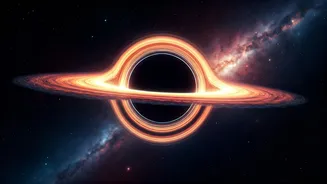
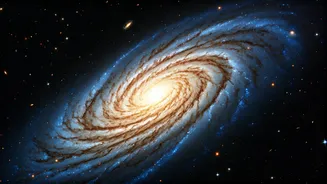
Most large galaxies, including our own Milky Way, are built around a supermassive black hole (SMBH). These behemoths, with masses millions or even billions of times that of our sun, are usually dormant. They sit quietly at the galactic center, their immense
gravity holding things together. For the most part, they are relatively peaceful, only occasionally sipping small amounts of gas or dust that wander too close. Our own galaxy's black hole, Sagittarius A*, is in this quiet phase. But as recent events have shown, this peaceful state is not always permanent.
What 'Activating' Actually Means
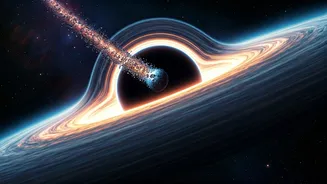
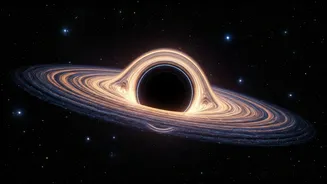
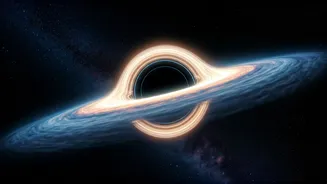
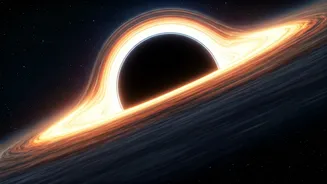
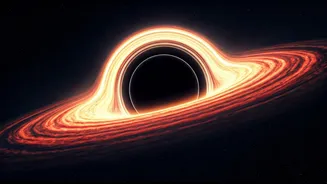
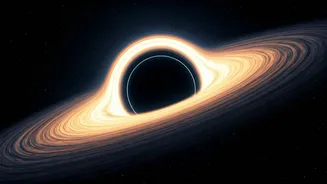
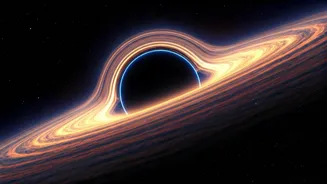
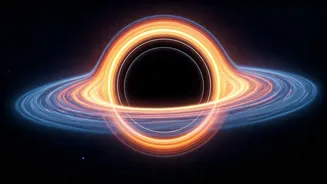
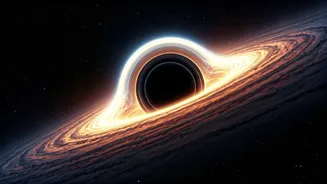
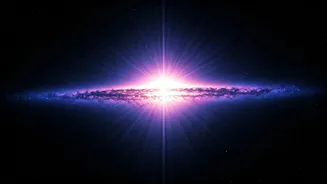
When a black hole 'activates,' it means it has started to actively feed on a large amount of material. This could be a star that strayed too close and was torn apart in a 'tidal disruption event,' or it could be a massive cloud of gas and dust. As this matter is pulled toward the black hole, it doesn't fall straight in. Instead, it forms a swirling, super-heated structure called an accretion disk. The friction and intense gravitational forces in this disk cause it to glow incredibly brightly across the entire electromagnetic spectrum, often outshining all the stars in the host galaxy combined. This transformed state is known as an Active Galactic Nucleus, or AGN.
A Sudden, Surprising Awakening
Recently, astronomers witnessed one of the most dramatic 'switching on' events ever seen. A distant galaxy's core, previously unremarkable, suddenly flared up, becoming one of the most luminous transient objects ever recorded. The event, designated J221951, was spotted by astronomers using the Neil Gehrels Swift Observatory. The object brightened dramatically in a very short span of time, indicating its central supermassive black hole had gone from dormant to active in what amounts to the blink of an eye in cosmic terms. This sudden activation after a long period of quiet took researchers completely by surprise.
How Astronomers Caught It in the Act
The discovery of J221951 was somewhat accidental. A team was originally searching for the source of a gravitational wave signal, thought to be from a kilonova—the merger of two neutron stars. While scanning the sky, they found J221951, but it didn't behave like a kilonova. Follow-up observations with other telescopes, including the Hubble Space Telescope, helped determine its immense distance—around 10 billion light-years away—and confirmed its extraordinary brightness. By comparing new images with archival data of the same patch of sky, they could confirm that a previously normal-looking galaxy had suddenly become incredibly luminous at its center.
The Galactic Consequences
An activated black hole has profound effects on its host galaxy. The immense radiation and powerful winds blasting from the accretion disk can heat up and blow away the surrounding gas. This process, known as 'AGN feedback,' can either trigger bursts of star formation by compressing gas clouds or halt star formation entirely by ejecting the raw materials needed to build stars. These cosmic winds can reshape the entire galactic ecosystem. While a spectacular and violent process, these events happen on galactic scales billions of light-years away and pose no threat whatsoever to us on Earth.
Why This Discovery Matters
Witnessing a supermassive black hole turn on in real-time is incredibly rare and provides a wealth of information. These events are a key missing piece in the puzzle of how galaxies evolve. By studying J221951, astronomers can test their models of black hole growth and AGN feedback. Continued monitoring will help scientists determine the exact cause—whether it was a star being ripped apart or a change in the accretion disk's state—and how much energy is being unleashed. Each new observation helps us understand the dynamic and ever-changing nature of the universe and the powerful engines that drive it.