

More Than Just Rings
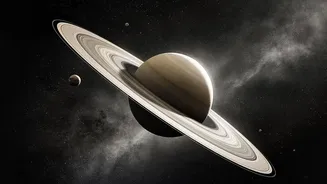
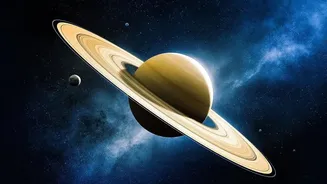
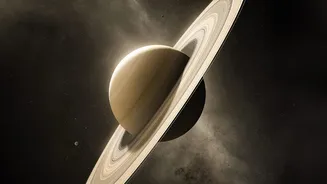
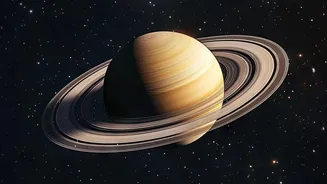
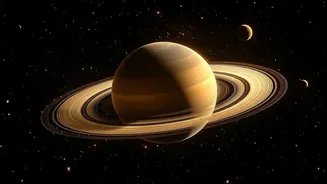
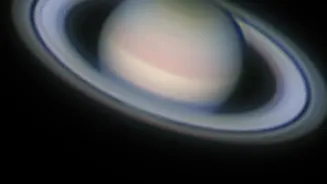
Saturn is instantly recognizable for its stunning system of icy rings, but the planet itself is a world of incredible dynamism and complexity. As the sixth planet from our Sun, it is a gas giant composed mostly of hydrogen and helium, with a turbulent
atmosphere shaped by fierce winds and colossal storms. Unlike Earth, with its solid surface, Saturn is a giant ball of gas where weather patterns can persist for decades. Scientists have long studied this restless atmosphere to understand the forces that govern planetary climates, and the latest observations are providing a clearer picture than ever before. Recent data, particularly from infrared observation, is allowing researchers to peer below the uppermost cloud layers, revealing hidden structures and movements.
A Season of Decades
To understand Saturn's seasons, you have to think on a much grander scale than we do on Earth. Our planet takes one year to orbit the Sun, and our 23-degree axial tilt creates our distinct seasons. Saturn also has a tilt, a similar 27 degrees, which is the mechanism that drives its seasonal changes. However, Saturn takes a leisurely 29 Earth years to complete a single orbit around the Sun. This means each of its four seasons lasts for more than seven Earth years, a period during which entire planetary hemispheres are bathed in continuous summer sunlight or plunged into prolonged winter darkness. As the planet progresses through its long year, the amount of solar energy reaching different parts of its atmosphere changes dramatically, triggering slow but massive shifts in its weather.
Hubble's Infrared Eye
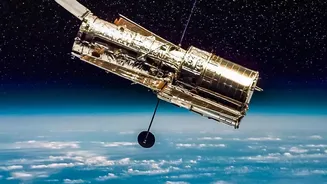
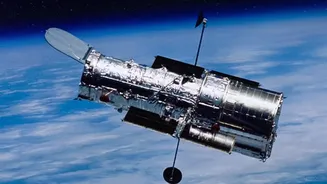
Seeing these seasonal shifts requires special tools. While visible light shows us the beautiful colors of Saturn's cloud bands, infrared light tells a deeper story. The Hubble Space Telescope, equipped with powerful infrared cameras, can detect heat and chemical signatures that are invisible to the naked eye. This allows scientists to measure temperature changes, map the altitude of different cloud and haze layers, and track the distribution of gases like methane and ammonia. Think of it like a planetary CT scan: where visible light only shows the surface, infrared allows astronomers to effectively slice through the atmosphere at multiple levels to see how the whole system works together.
Tracking a Changing Atmosphere
By observing Saturn annually, programs like the Outer Planet Atmospheres Legacy (OPAL) have built a critical long-term record of its climate. Observations taken between 2018 and 2020 showed the northern hemisphere as it transitioned from its long summer towards autumn. During this period, astronomers noted subtle but significant year-to-year changes. For instance, Saturn's equator brightened by 5 to 10 percent, and winds near the equator appeared to slow slightly. These observations are snapshots of a much larger climatic evolution. More recent observations in 2024 from both Hubble and the James Webb Space Telescope have provided an even more comprehensive view, capturing the planet as it approaches its 2025 equinox, a time of rapid atmospheric change.
A Laboratory for Planetary Science
Studying Saturn’s seasons does more than just tell us about one distant planet. It provides a natural laboratory for understanding the fundamental principles of atmospheric physics that apply across the cosmos. The data helps scientists refine their models of how gas giants form and evolve. For example, joint observations with the James Webb Space Telescope have revealed long-lived jet streams and the lingering remnants of giant storms from over a decade ago, showing how deep winds shape the visible atmosphere. Understanding the feedback loop between sunlight, atmospheric chemistry, and weather on Saturn helps explain similar processes on Jupiter, Uranus, and even the many gas giant exoplanets being discovered around other stars. These far-off weather reports help piece together the puzzle of how planetary climates, including our own, work.