

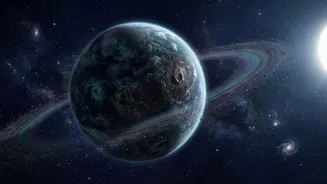
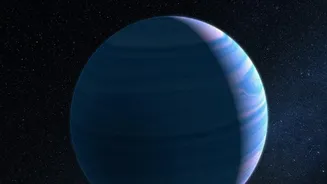
In the vast theatre of the cosmos, planets don't just disappear. Yet, that’s exactly what seemed to happen with Fomalhaut b, a celestial body once celebrated as one of the first exoplanets ever directly imaged.
A Landmark Discovery
In 2008, the world of astronomy was buzzing.
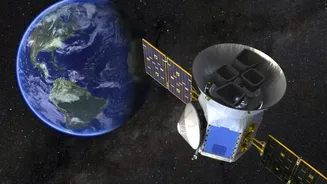
Scientists, using data from the Hubble Space Telescope, announced the direct observation of a planet orbiting the star Fomalhaut, just 25 light-years away. This was a monumental achievement. Most exoplanets are detected indirectly, by observing the dimming of a star as a planet passes in front of it or the gravitational 'wobble' a planet induces on its star. Seeing a planet, named Fomalhaut b, as a distinct point of light was a breakthrough. Initial estimates suggested it was a gas giant, perhaps up to three times the mass of Jupiter, on a long, looping orbit. It was a triumph for planet-hunters and the Hubble telescope, offering a rare, direct glimpse into another solar system.
A Puzzling 'Planet'
Almost immediately, however, Fomalhaut b started to show some strange behaviour. For a planet of its supposed size and youth, it should have been warm enough to emit a strong heat signature in the infrared spectrum. But when astronomers pointed infrared telescopes like NASA's Spitzer Space Telescope at it, they found nothing. The object was surprisingly bright in visible light, but invisible in the infrared, a behaviour that didn't fit any standard model of a planet. Astronomers theorised that perhaps the planet was surrounded by a massive ring or shell of dust, which was reflecting starlight and making it appear brighter than it was. Its orbit was also highly unusual, seemingly taking it on a path that would cross the vast, icy debris ring surrounding the Fomalhaut star. These inconsistencies made Fomalhaut b a fascinating but frustrating puzzle.
The Vanishing Act
The mystery deepened dramatically when astronomers analysed later Hubble images. When András Gáspár and George Rieke from the University of Arizona looked at data captured in 2014, they received a shock: Fomalhaut b was gone. It had vanished completely. Reviewing the full sequence of images from 2004 to 2014 revealed a clear pattern. The object wasn't just moving; it was fading and expanding over time. As Gáspár noted, the object 'was doing things a bona fide planet should not be doing'. A real planet doesn't expand, fade, and then disappear from view. It became clear that whatever Hubble had seen, it wasn't a stable planetary body.
Ghost Planet, Cosmic Collision
The definitive explanation, published in 2020, was even more spectacular than the original discovery. Fomalhaut b was never a planet at all. Instead, astronomers had been 'at the right place at the right time' to witness the aftermath of a rare and colossal collision between two massive, icy bodies. Gáspár and Rieke's models showed that the 'planet' was actually a vast, expanding cloud of fine dust created when two planetesimals, each about 200 kilometres across, smashed into each other. The initial impact created a dense, bright cloud of dust that reflected the light from Fomalhaut, mimicking the appearance of a planet. Over the next decade, this cloud expanded and dispersed. By 2014, the dust had spread out so much that it was no longer detectable by Hubble, creating the illusion of a vanishing planet. The cloud is now estimated to be over 200 million miles across.
What This Phantom Tells Us
While the loss of a 'planet' might seem like a disappointment, the discovery of this giant collision is arguably more significant. These events are thought to be a fundamental part of how planetary systems form and evolve, but they are incredibly rare to witness. The Fomalhaut system collision is estimated to happen only once every 200,000 years. Observing it provides a 'blueprint of how planets destroy each other' and how debris discs are shaped, according to George Rieke. The analysis showed the dust cloud wasn't in a stable orbit but on an 'escape trajectory,' further confirming it resulted from a violent, one off event rather than a stable planet's motion. Later observations by the James Webb Space Telescope in 2023 confirmed the absence of any planet, solidifying the collision theory.