





What Is a Conjunction?
In astronomy, a conjunction is a celestial event where two or more objects appear to be close to each other in the sky, as seen from our perspective on Earth. It's an optical illusion; the planets, moons, and stars involved are actually millions of kilometres
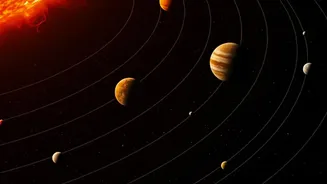
apart. This alignment happens because the planets in our solar system orbit the Sun on roughly the same plane. When the Moon pairs up with a bright planet like Saturn, it creates a beautiful and easily observable sight, often visible even without special equipment.
When and Where to Look
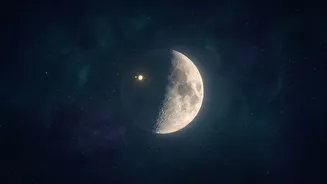
The main event for Indian sky-watchers occurs over several nights in late October. On the nights of October 23 and 24, 2026, the Moon will make a close approach to Saturn. Look towards the east-southeastern sky after dusk. On October 23, the nearly full Moon will be to the upper right of Saturn. The following night, October 24, you'll find the Moon has moved to the upper left of the planet. Saturn itself will have been shining brightly all month, as it reached opposition—its closest point to Earth for the year—on October 4, making it appear brighter than usual all night long.
How to Identify Saturn
Finding Saturn is easier than you might think, especially with the Moon as your guide. On the nights of the conjunction, it will be the bright 'star' near the Moon. A key difference between planets and stars is that planets tend to shine with a steady light, while stars twinkle. Saturn will appear as a bright, yellowish or golden dot of light that doesn’t flicker. It will be visible to the naked eye, so you won't need any special equipment to spot the pairing.
Enhancing Your View
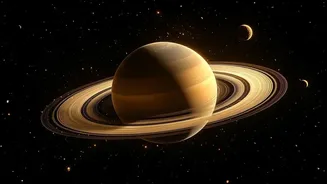
While you can enjoy the conjunction with just your eyes, a pair of binoculars or a small telescope will reveal much more detail. With good binoculars, Saturn may appear as a slightly elongated or flattened disk rather than a pinpoint of light. A beginner's telescope, even a modest one, can be powerful enough to show Saturn's famous rings. October 2026 is a great time to view them, as they will be tilted about 10 degrees towards our line of sight. You might even catch a glimpse of Titan, Saturn's largest moon, which appears as a faint dot of light next to the planet.
Tips for the Best Experience
To make the most of this celestial event, try to find a location away from bright city lights. Light pollution can wash out the sky and make it harder to see fainter objects. Give your eyes about 20-30 minutes to fully adjust to the darkness; this will dramatically improve what you can see. Dressing warmly is also a good idea, as even cool evenings can feel chilly when you’re standing still for a long time. Finally, consider using a stargazing app on your phone, like Stellarium or Sky Walk. These apps can help you pinpoint the exact location of planets and constellations in real-time from your location in India.