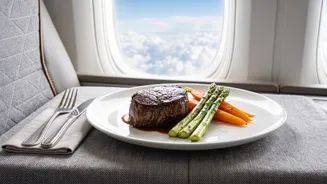








You're cruising at 35,000 feet, and the meal cart arrives. Yet, the food that looked appealing often tastes disappointingly bland. It’s not always the chef's fault. The answer lies in how the unique environment inside an airplane cabin hijacks your senses.
It's Not Just One Thing, It's Everything
The blame for bland airplane food can't be placed on a single culprit. It’s a multi-pronged attack on your senses. First, the cabin pressure is kept at an equivalent altitude of 6,000 to 8,000 feet. This thinner air slightly reduces your blood oxygen saturation, which can dull your taste and smell receptors. Then there's the humidity, or lack thereof. Cabin air is incredibly dry, often hovering below 12%—drier than most deserts. This parched environment dries out the mucous membranes in your nose. Since your sense of smell accounts for up to 80% of what you perceive as flavor, this is a major blow to your palate before you even take a bite. It's a similar effect to having a bad cold, where everything tastes muted.
The Deafening Hum Muffles Flavor
Beyond pressure and humidity, there's a constant, unavoidable factor: noise. The steady 85-decibel roar of the engines isn't just background sound; it actively messes with your taste perception. Studies from Cornell University and other institutions have found that loud noise can suppress certain tastes. Specifically, our ability to perceive sweetness and, to a lesser extent, saltiness takes a significant hit. Research commissioned by Lufthansa at Germany’s Fraunhofer Institute found that sensitivity to sweet and salty flavors can drop by as much as 30% in flight. This is why a dish that was perfectly seasoned on the ground can taste flat in the air.
Enter Umami, the Fifth-Taste Hero
Just when it seems all hope is lost for a flavorful in-flight meal, a hero emerges: umami. Often called the fifth basic taste alongside sweet, salty, sour, and bitter, umami is the savory, brothy, and rich flavor found in ingredients like aged cheeses, mushrooms, seaweed, soy sauce, and, most famously, tomatoes. Here's the fascinating part: while the cabin environment dulls sweetness and saltiness, it doesn't have the same effect on umami. In fact, some research suggests that the loud background noise actually enhances our perception of umami. Suddenly, the enduring popularity of ordering a Bloody Mary or a simple tomato juice on a flight makes perfect scientific sense.
Designing Menus for the Sky
Airlines and their caterers are well aware of this sensory science. They don't just load restaurant food onto planes; they engage in 'gastrophysics' to engineer menus that can withstand the punishing cabin environment. Knowing that umami is the flavor that punches through, airline chefs intentionally build menus around it. You’ll find an abundance of umami-rich ingredients designed to deliver flavor despite the conditions. Think tomato-based sauces, mushroom ragouts, parmesan-dusted pastas, and soy_glazed meats. They lean into bold, spicy, and acidic flavors, which also remain relatively stable at altitude. So the next time you see a curry or a rich tomato dish on the menu, it’s not a coincidence—it's a deliberate culinary strategy to make your meal more enjoyable at 35,000 feet.