
Cleopatra’s Legendary Milk Baths
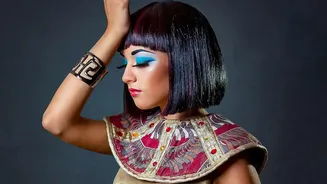
Perhaps no royal is more famous for her beauty regimen than Cleopatra, the last queen of Egypt. Legend holds that she regularly bathed in milk and honey to maintain her famously soft and radiant skin. This wasn't just decadent indulgence; it was clever
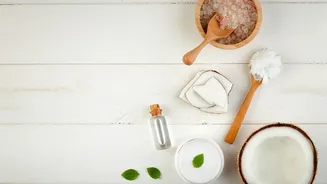
chemistry. Milk is rich in lactic acid, a natural alpha-hydroxy acid (AHA) that gently exfoliates by dissolving the bonds holding dead skin cells together. This process reveals smoother, brighter skin underneath. Honey, a natural humectant, draws moisture into the skin and possesses antibacterial properties, making the combination a perfect spa treatment for softening and clarifying the complexion. Cleopatra is also said to have used Dead Sea salts for their mineral-rich, skin-clearing properties and various natural oils like castor and sesame to nourish her skin in the dry Egyptian climate.
The Ubtan Rituals of Indian Maharanis
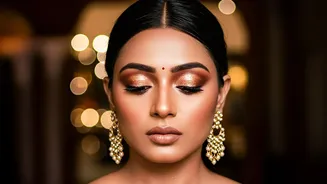
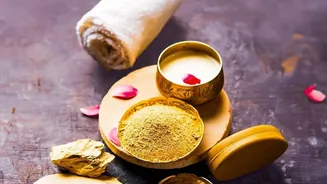
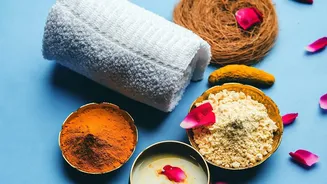
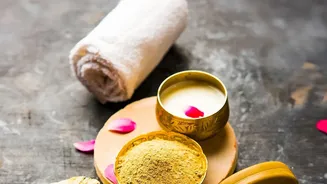
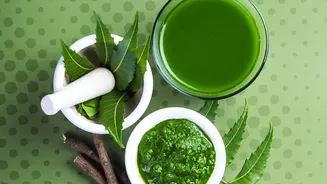
In the royal courts of India, beauty was deeply intertwined with Ayurvedic wisdom. Queens and princesses relied on 'Ubtan,' a traditional paste made from a blend of natural ingredients, to achieve a luminous glow. The specific recipe often varied by region but typically included chickpea flour (besan) as a base, turmeric (haldi) for its anti-inflammatory and brightening properties, and sandalwood (chandan) for its cooling and soothing effects. These ingredients were mixed with milk or rose water to form a paste that was scrubbed onto the skin before bathing. This ritual, central to pre-wedding ceremonies even today, gently exfoliates, removes tan, and leaves the skin feeling soft and purified. Mughal queens like Nur Jahan were known to favour saffron-infused milk for a radiant complexion, a prized ingredient that helps reduce pigmentation.
Maharani Gayatri Devi’s Elegant Simplicity
Celebrated for her classic beauty and style, Maharani Gayatri Devi of Jaipur championed a more minimalist approach to beauty. Her regimen was said to include simple, natural ingredients. She reportedly used perfumed oils in her bath and applied a turmeric paste to enhance her skin's glow. Henna was another staple, used not just for decorative purposes but also as a natural hair conditioner and cooling agent for the scalp. Her beauty philosophy seemed to focus on enhancing her natural features rather than concealing them, often favouring minimal makeup consisting of kohl-lined eyes and soft shades of lipstick. This less-is-more approach, combined with the use of potent natural ingredients like turmeric, reflects a timeless understanding of skin health.
Marie Antoinette's Floral Formulations
At the opulent court of Versailles, Queen Marie Antoinette of France indulged in elaborate beauty routines. She was known for her complex skincare, which included a face cleanser called 'Eau Cosmetique de Pigeon' and a toner, 'Eau des Charmes,' derived from grapevines. She was also a proponent of face masks, using one made with cognac, dry milk powder, egg white, and lemon juice to brighten and tighten her skin. For her baths, she preferred a soothing mix of pine nuts, linseed, and sweet almonds. To maintain her famous strawberry blonde hair, she reportedly used a paste of saffron, turmeric, sandalwood, and rhubarb. Her routine also included softening her hands overnight by wearing gloves filled with wax, sweet almond oil, and rose water.
The Rice Water Secret of Japanese Geishas
While not royalty in the traditional sense, Japanese Geishas perfected beauty rituals that have been passed down for centuries. A cornerstone of their skincare was the humble rice water, the milky liquid left over after washing rice. This practice dates back to the Heian period, when court ladies used it to maintain their famously luminous complexions. Geishas adopted this secret to cleanse and brighten the skin beneath their iconic white makeup. Modern science shows that rice water is rich in vitamins, minerals, and antioxidants that can help improve skin elasticity and even out skin tone. It was used as a facial wash or soak, and even to nourish their long, healthy hair, making it a versatile and effective beauty elixir derived from a simple kitchen staple.