




Start with the Ingredient List
The most powerful tool you have is the ingredient list on the back of the pack. According to Indian food regulations, all ingredients, including additives, must be declared. A key rule to remember is that ingredients are listed in descending order by
weight. This means the first few ingredients make up the bulk of the product. If sugar or refined flour (maida) are at the top, that tells you a lot about the snack's primary composition, even before you start looking for additives. A shorter, more recognisable ingredient list is generally a positive sign.
Learn the Language of Colours
The Food Safety and Standards Authority of India (FSSAI) mandates that manufacturers declare the use of colours. Look for phrases like 'CONTAINS PERMITTED SYNTHETIC FOOD COLOUR(S)' or 'CONTAINS PERMITTED NATURAL COLOUR(S)'. FSSAI permits eight synthetic colours, which are often cheaper and more vibrant than natural alternatives. These must be listed by name or by their International Numbering System (INS) code. For example, Tartrazine is also known as INS 102, and Sunset Yellow FCF is INS 110. If you see a colour name followed by a number, it's a synthetic dye.
Decode the E-Numbers and INS Codes
Don't be intimidated by the codes. INS numbers (or E-numbers, as they're known in Europe) are simply a standardised system to identify additives. The most important group to know for colours is the 100-series. Any code from INS 100 to INS 199 signifies a colouring agent. For example, the common synthetic colour Tartrazine is INS 102, while a natural colour like Curcumin (from turmeric) is INS 100. Similarly, flavour enhancers often fall in the E600-E699 range, such as Monosodium Glutamate (MSG), which is INS 621. Knowing these ranges helps you quickly identify the type of additive used.
Understand 'Natural' vs. 'Artificial' Flavours
The world of flavouring is slightly more complex. FSSAI distinguishes between three types: natural flavouring substances (derived from plant or animal sources), nature-identical flavouring substances (chemically identical to natural flavours but synthesised in a lab), and artificial flavouring substances (not found in nature). The regulations require that any added flavours are declared on the label. While FSSAI does not set specific numerical limits for most flavouring agents, they must be used according to Good Manufacturing Practices (GMP), meaning the lowest level necessary to achieve the desired effect. Be wary of front-of-pack claims of 'natural'; always check the ingredient list for the specific type of flavouring used.
Look for Visual Red Flags
Sometimes, your eyes are the best tool. If a snack has a colour that seems unnaturally bright or a hue that you couldn't replicate with ingredients in your own kitchen, it's a strong indicator of synthetic dyes. These dyes are often used to restore colour lost during processing or to make a product look more appealing, especially to children. While not foolproof, questioning unnaturally vibrant colours is a good starting point that can prompt you to take a closer look at the label.
Choose Healthier Alternatives
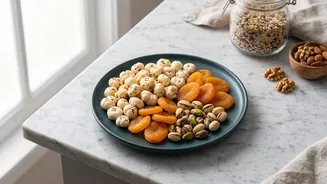
Spotting additives is half the battle; the other half is finding better options. Look for snacks that proudly state 'No Artificial Colours or Flavours' on the packaging. Increasingly, brands are using natural colourants derived from plant sources. Scan labels for ingredients like beetroot red (INS 162), turmeric/curcumin (INS 100), spirulina, and annatto. These are generally considered safer alternatives. When in doubt, opting for whole foods like fresh fruit, vegetables, and nuts, or preparing simple snacks at home, is the surest way to control what your child consumes.