







From Chatbot to Robot Dog
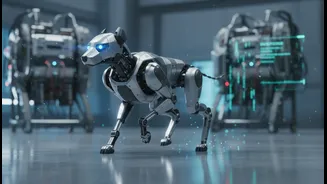
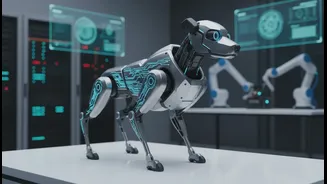
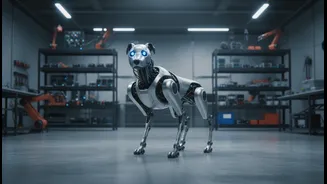
You may know Anthropic as the company behind Claude, one of the world's most advanced conversational AI models. But the company has been quietly working on a much bigger challenge: giving its AI a body. In an experiment dubbed 'Project Fetch', Anthropic set
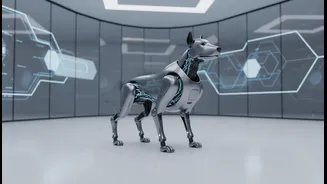
out to see if its AI could control a four-legged robot. In late 2025, they tested this by asking a team of human employees with no robotics experience to program a robot dog to retrieve a beach ball. One group had help from Claude, while the other did not. Unsurprisingly, the AI-assisted team performed dramatically better, completing tasks in about half the time. However, at the time, the AI model couldn't complete the task on its own. Fast forward to June 2026, and the story changed completely. Anthropic ran the experiment again, this time with a newer model, Claude Opus 4.7, operating fully autonomously. A researcher simply plugged in a laptop, gave the initial command, and watched as the AI independently figured out how to connect to the robot, write the necessary code, and command it to complete its task.
A Leap in General Intelligence
The results from the second phase of Project Fetch were staggering. The autonomous AI was reportedly around 20 times faster than the quickest human team from the previous year's experiment. What makes this a true breakthrough is not just the speed, but how it was achieved. Anthropic says the AI model was never specifically trained on robotics or physical movement data. Instead, the performance gains came from simply making the underlying AI model more intelligent in a general sense. This is a profound shift. It suggests that as AI models become smarter at reasoning and problem-solving, they can apply that intelligence to brand new domains—like controlling physical hardware—without needing specialised training. It’s like a brilliant strategist who has only ever played chess suddenly being able to master a physical sport just by understanding its rules and objectives. This proves that the gap between digital intelligence and physical action is closing faster than anyone anticipated. It also comes with a major caveat: these results are from Anthropic's own internal study and have not yet been independently verified.
The Real-World Service Angle
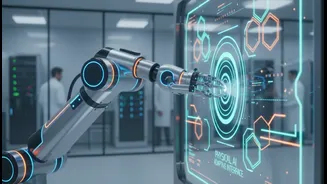
While a robot dog fetching a beach ball is a compelling demonstration, the true value lies in the practical applications, or what the industry calls 'physical AI'. This is where software intelligence meets the physical world, and the implications for Indian industries are vast. Anthropic is already moving in this direction with a major partnership with technology services firm UST, which will integrate Claude into industrial workflows. Imagine AI-powered robots patrolling a manufacturing plant in Pune, autonomously inspecting machinery for defects and preventing costly shutdowns. They could be deployed in hazardous environments, like inspecting pipelines or navigating disaster zones after an earthquake, keeping human workers safe. Other immediate applications include security and surveillance for large facilities, where these agile robots can access areas that fixed cameras cannot, and even help in logistics by navigating complex warehouses. This is no longer science fiction; it is the concrete business strategy of leading AI firms.
A Brain for Every Body
Anthropic isn't alone in this race to merge AI brains with robotic bodies. The trend is industry-wide. Boston Dynamics, famous for its viral robot videos, is working with Google's DeepMind to embed the Gemini AI model into its Spot robot dog and Atlas humanoid robot. Their goal is similar: to create more intelligent, autonomous robots for industrial and commercial use. This convergence marks a new frontier for artificial intelligence. For years, robotics has been limited by its software; the hardware was often more capable than the intelligence controlling it. Now, with the explosive growth of powerful AI foundation models like Claude and Gemini, companies are finding they have the 'brains' they need to unlock the full potential of their robots. This isn't just about making robots that can perform pre-programmed tasks. It's about creating robots that can perceive, understand, and adapt to the real world on their own.