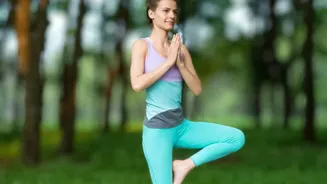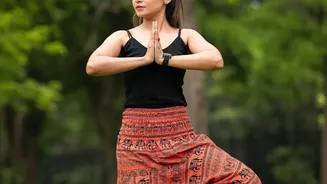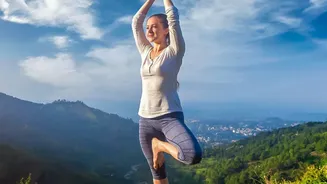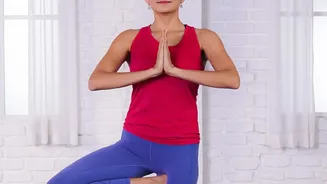




Feeling steady on your feet is key to moving through life with confidence. Tree Pose, or Vrikshasana, is a classic yoga posture that builds stability, strengthens your legs, and calms your focus, all from the comfort of your home.
What is Tree Pose?
Vrikshasana (pronounced
vrik-SHAS-uh-nuh) translates from Sanskrit as 'Tree Pose'. It’s a standing balance posture that mirrors the graceful, steady stance of a tree—rooted firmly in the ground while growing tall. The pose challenges both your physical equilibrium and your mental concentration, making it a foundational practice for improving stability, posture, and focus. Its benefits are significant: it strengthens the ligaments and tendons in your feet, tones the entire standing leg and core, and helps open the hips. The quiet focus required can also create a meditative effect, helping to calm the mind.
How to Do the Classic Tree Pose
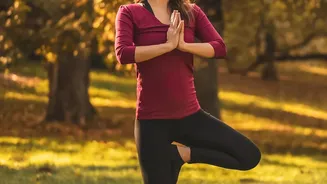
Finding your balance in Tree Pose is a gradual process. Rushing often leads to wobbling, so move with intention. Start in Mountain Pose (Tadasana), standing tall with your feet together or hip-width apart. Distribute your weight evenly and feel your connection to the ground. Shift your weight onto your left foot, engaging the muscles of the leg. Now, bend your right knee and place the sole of your right foot on your inner left leg. You can place it high on the inner thigh or on the inner calf, but never directly on the knee joint, as this can cause injury. Press the foot and the standing leg gently into each other to create stability. Keep your hips level and facing forward. Bring your palms together in a prayer position at your chest. To help maintain balance, fix your gaze on a single, unmoving point in front of you (this is called a 'drishti'). Hold for 20 to 60 seconds, breathing steadily, before gently releasing and repeating on the other side.
Safety First: Common Mistakes to Avoid
To practice safely and effectively, be mindful of common alignment issues. The most critical rule is to avoid placing your foot directly on the side of your knee. This puts unnecessary pressure on the joint. Always position the foot above or below the knee. Another common mistake is locking the standing knee; instead, keep a micro-bend in the joint to allow for small adjustments and avoid strain. Many people also hold their breath when they feel unsteady, but this creates tension. Focus on smooth, even breaths to support your balance. Finally, avoid letting your hip jut out to the side. Keep both hips square to the front to maintain core engagement and stability.
Supportive Roots: Variations for Beginners
If you're new to balance poses or feeling unsteady, modifications are your friend. The simplest variation is a 'kickstand' tree, where you rest your heel on your inner ankle while keeping the toes of your lifted foot on the floor for support. This helps you practice alignment without the full balance challenge. You can also practice near a wall or a sturdy chair, keeping a hand lightly on it for support as you build confidence. Another option is the 'low-branch' tree, where you place the sole of your foot on your inner calf instead of the thigh. This lowers your centre of gravity and is a great stepping stone to the full pose.
Growing Your Branches: Intermediate and Advanced Variations
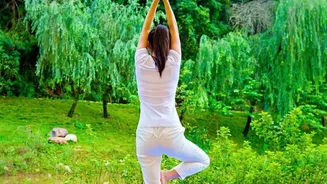
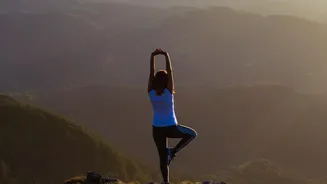
Once you feel stable in the classic pose, you can explore variations to deepen the challenge. Try changing your arm position by reaching them overhead in a 'V' shape or out to the sides like branches. For an added stability test, you can introduce 'windy tree' by gently swaying your arms while keeping your legs and core steady. To further challenge your balance, try closing your eyes for a few seconds. More advanced practitioners can explore a Half-Lotus Tree, placing the top of the foot on the opposite hip crease, which adds a deep hip opener. Another advanced option is adding a side bend, reaching one arm overhead and bending your torso to the side while in the pose.