



Just How Slow Are We Talking?
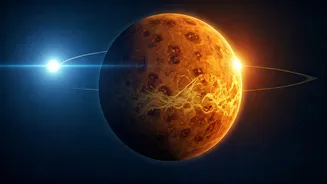
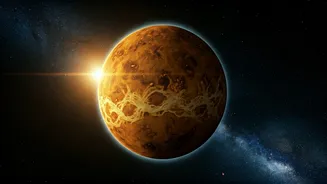
To put it simply, Venus is the solar system's slowest spinner. While Earth completes a rotation on its axis every 24 hours, giving us our familiar day-night cycle, Venus takes its sweet time. A single sidereal day on Venus—the time it takes for the planet
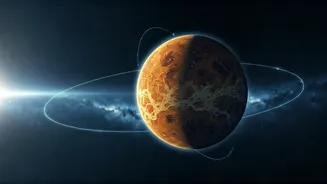
to rotate once on its axis—is about 243 Earth days. For context, that means if you were to stand on Venus, you'd have to wait over eight months for the planet to complete just one turn. By contrast, a Venusian year—the time it takes to orbit the Sun—is only about 225 Earth days. Yes, you read that right: on Venus, a day is longer than a year. This makes it unique among all the planets in our solar system.
The Day-Year Paradox Explained
This concept can be tricky to wrap your head around. Let's break it down. We have two main ways of measuring a 'day'. A 'sidereal day' is one full 360-degree rotation relative to the distant stars. A 'solar day' is the time it takes for the Sun to return to the same position in the sky. On Earth, they are very similar (a sidereal day is 23 hours and 56 minutes). On Venus, the difference is huge. Because the planet is rotating so slowly *and* orbiting the Sun, a solar day on Venus (from one sunrise to the next) is about 117 Earth days long. So even though its full rotation takes 243 Earth days, you’d experience a sunrise about twice per Venusian year. It’s a mind-bending piece of cosmic clockwork.
Spinning the Wrong Way, Too
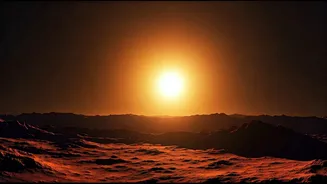
As if being the slowest wasn't enough, Venus also spins backward. With the exception of Uranus, which is knocked on its side, every other planet in our solar system rotates on its axis in a counter-clockwise direction (prograde). Venus, however, spins clockwise (retrograde). This means that if you could stand on the surface of Venus (which you can't, but we'll get to that), you would see the Sun rise in the west and set in the east. This retrograde rotation, combined with its snail-like pace, makes Venus a true planetary oddball. Scientists have been trying to figure out exactly why for decades.
Why the Bizarre Spin? The Leading Theories
There isn’t one definitive answer, but scientists have a couple of strong theories. The first, and most dramatic, is a story of a violent past. Early in its history, Venus may have been struck by a massive asteroid or planetoid. Such a colossal impact could have been powerful enough to not only slow its original rotation to a crawl but completely reverse its direction. Another compelling theory points to its incredibly thick and heavy atmosphere. Venus's atmosphere is about 90 times denser than Earth's, creating immense pressure. This dense, fast-moving atmosphere may have created strong atmospheric tides that, over billions of years, acted as a brake, slowing the planet's spin and eventually causing it to reverse. It’s possible a combination of these factors is responsible.
What This Means for the Planet
This super-slow rotation has profound consequences for Venus. With each side of the planet facing the Sun for nearly two Earth months at a time, temperatures soar. The surface of Venus is a scorching 465 degrees Celsius, hot enough to melt lead. This heat is trapped by a runaway greenhouse effect caused by its dense carbon dioxide atmosphere. The long days and nights don't create the kind of temperature swings you might expect, because the thick atmosphere is incredibly effective at distributing heat around the planet, keeping even the night side hellishly hot. The crushing atmospheric pressure and searing heat make Venus the most inhospitable planet in the solar system—a reality directly tied to its strange, slow dance.