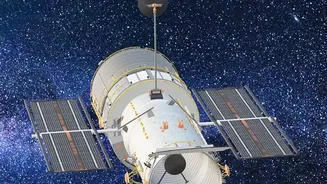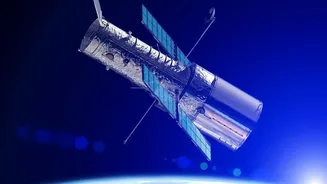








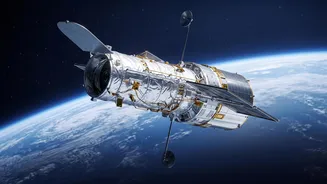
For over 35 years, the Hubble Space Telescope has been humanity's eye on the cosmos, delivering breathtaking images and revolutionary science. But its time could be running out, and NASA is now looking for a hero from an unlikely place.
A Legend Losing Altitude
The Hubble Space
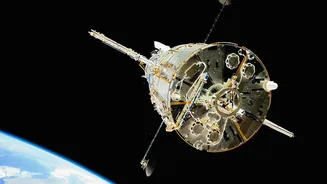
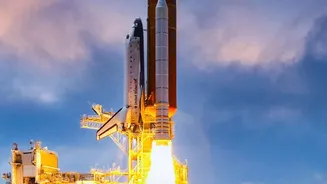
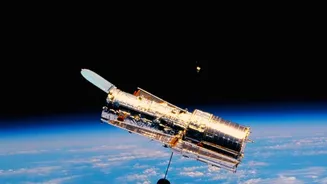
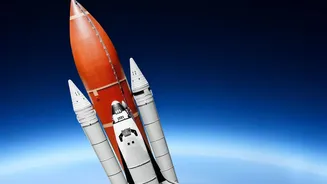
Telescope is not failing; it is falling. Like any object in low-Earth orbit, it experiences faint atmospheric drag that slowly, but relentlessly, pulls it closer to Earth. Launched in 1990 to an altitude of over 600 kilometres, it now orbits significantly lower. Projections show that without intervention, this orbital decay will cause the telescope to make an uncontrolled re-entry into the atmosphere sometime in the mid-2030s. Since the Space Shuttle program was retired in 2011, NASA has lacked a dedicated vehicle to service the telescope, which was last visited by astronauts in 2009. With no onboard propulsion system to correct its course, Hubble's fate depends on a lift from someone else.
A Call for Commercial Heroes
In late October 2026, NASA officially sent out a call for help, issuing a 'Request for Information' (RFI). This is not a contract, but a way for the agency to survey the burgeoning commercial space industry and understand what is possible. The RFI outlines three potential missions for a private partner: boost Hubble to a higher, more stable orbit of at least 600 kilometres; service the telescope to repair or upgrade its systems; or, as a last resort, guide it to a safe, controlled de-orbit over the ocean. The responding company would be responsible for the entire mission, including the launch vehicle, spacecraft, and operations, with a deadline to complete the mission by 2032.
Potential Players and Past Proposals
This isn't the first time a commercial rescue has been considered. In 2022, NASA and SpaceX signed an agreement to study the feasibility of using a Dragon spacecraft for a reboost mission, a plan championed by the Polaris Program led by billionaire entrepreneur Jared Isaacman. However, NASA ultimately decided not to pursue that specific path in 2024, citing risks. Now, with Isaacman as NASA's Administrator, the idea is back on the table, but the call has been opened to the entire industry. Companies like SpaceX are seen as likely contenders, but the RFI invites any firm with the capability to present a plan, whether it's a robotic tug or a crewed mission.
More Than Just a Nudge
A successful mission would do more than just save Hubble from a fiery end. Pushing it to a higher orbit could add another 15 to 25 years to its operational life, allowing it to continue its unique scientific work. Hubble's ability to observe in ultraviolet and visible light is a crucial complement to the infrared focus of the James Webb Space Telescope. Extending its mission would allow astronomers to continue studying everything from exoplanet atmospheres to the expansion of the universe well into the 2030s and beyond. Some proposals might even include servicing components, potentially upgrading the 36-year-old observatory's aging hardware for even better performance.
A New Model for Space Operations
This initiative is bigger than just one telescope. It represents a major shift in how legacy space assets are managed, blending government oversight with private sector agility and innovation. If a commercial company can successfully and cost effectively service Hubble, it could create a new market for extending the lives of other valuable satellites in orbit. The challenge is significant; a recent attempt by another company to rescue a different NASA observatory, the Swift Telescope, was unsuccessful due to technical issues, highlighting the risks involved. However, a successful Hubble mission would prove the viability of public private partnerships for complex on orbit servicing, paving the way for a more sustainable future in space.