


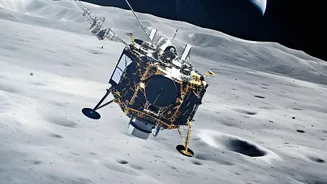
The Moon’s Invisible Threat
Earth’s magnetic field and thick atmosphere protect us from the constant barrage of galactic cosmic rays and violent solar radiation. The Moon has neither. An astronaut on the lunar surface is exposed to radiation levels that can be 200 times higher than
on Earth. For short visits like the Apollo missions, the risk was manageable. But for long-term habitation, this exposure can damage DNA, increase cancer risks, and lead to other serious health problems. Building surface habitats with sufficient shielding would require transporting massive amounts of material from Earth, an incredibly expensive and complex undertaking. This radiation problem is one of the single biggest hurdles to establishing a permanent human presence on the Moon.
Nature's Underground Shelters
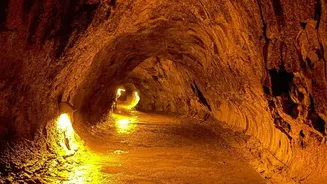
The most promising solution may not be something we build, but something we find. Billions of years ago, when the Moon was volcanically active, rivers of lava carved out vast underground tunnels. As the lava flowed away, it left behind enormous, hollow conduits known as lava tubes. Some of these tubes are thought to be vast, potentially miles long and wide enough to contain entire cities, with ceilings made of solid volcanic rock over 100 feet thick. This massive rock overburden provides a natural, pre-built shield against the harsh lunar environment, offering near-total protection from radiation, micrometeoroid impacts, and extreme temperature swings that plague the surface. Inside a lava tube, radiation levels could drop to be comparable with those on Earth, making long-term habitation feasible.
Enter the Cave Explorers
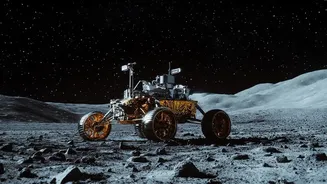
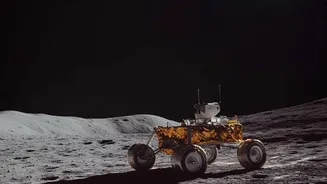
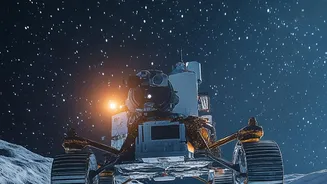
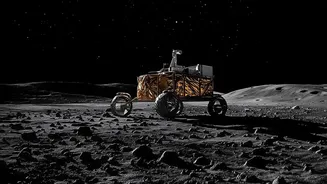
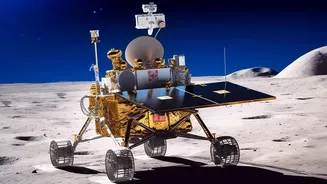
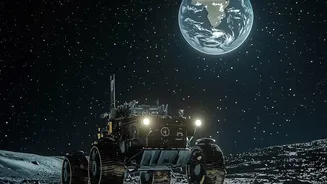
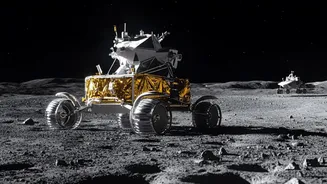
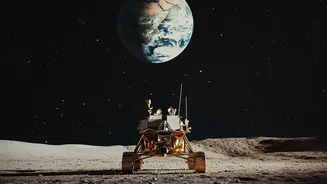
Finding and assessing these subterranean havens is a job for a new class of robotic explorer. Surface rovers are not equipped for the unique challenges of descending into pits and navigating dark, unknown, and potentially treacherous underground terrain. In response, space agencies and private companies are developing specialized subterranean rovers. Concepts range from two-wheeled rovers designed to be lowered into pits, to swarms of smaller, shoebox-sized robots that can work together. One project, called CADRE (Cooperative Autonomous Distributed Robotic Exploration), will use a team of small rovers with ground-penetrating radar to create 3D maps of the subsurface without direct human control. Another recent NASA-funded concept involves a laser-powered drone tethered to a surface rover by a fiber-optic cable, allowing it to explore deep inside caves.
Mapping for a Lunar Future
The primary mission for these robotic scouts is to assess the suitability of lava tubes as future habitats. They will be looking for stable, structurally sound tunnels of significant size. Their ground-penetrating radar will map the dimensions of the tubes and the thickness of the rock ceiling above. Beyond just confirming size and stability, these rovers will search for valuable resources. The most critical of these is water ice, which could be trapped in permanently shadowed regions within the caves. Finding water would be a game-changer, as it could be used for drinking, creating breathable air, and producing rocket fuel. These missions will create the first detailed maps of the lunar underworld, identifying the prime real estate for humanity's first off-world outpost.
More Than Just a Shield
While radiation protection is the headline benefit, lava tubes offer much more. The lunar surface experiences extreme temperature swings, from a scorching 123°C in daylight to a frigid -248°C at night. Inside a lava tube, however, the temperature is expected to be a relatively stable and constant -20°C. This thermal stability drastically simplifies the engineering challenges of building habitats and equipment, which would no longer need to withstand such wild fluctuations. Furthermore, the thick rock ceiling provides excellent protection from the constant threat of micrometeorite impacts that bombard the airless surface. Using existing tubes also means less construction material needs to be launched from Earth, saving immense cost and enabling more payload mass to be dedicated to science and other critical hardware.