


A Planet of Thin Air
At first glance, powerful winds on Mars seem impossible. The Martian atmosphere is famously tenuous, with a surface pressure and density only about 1% of Earth's. For decades, this led many scientists to believe the winds were simply too feeble to move
significant amounts of sand, and that the vast dune fields seen by early orbiters were ancient relics from a time when the atmosphere was much thicker. Standing on the surface, even a 100 km/h gust would feel more like a light breeze to a human because there are so few air molecules to push against. It created a genuine puzzle: how could such a weak atmosphere sculpt such massive geological features?
Seeing the Dunes in Motion
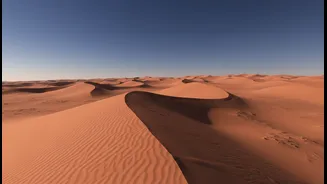
The game changed with long-term monitoring from orbit. High-resolution cameras, especially the HiRISE instrument aboard NASA's Mars Reconnaissance Orbiter (MRO), allowed scientists to compare images of the same dune fields taken years apart. The evidence was undeniable. In regions like Nili Patera, entire dunes were seen migrating across the landscape. By tracking the movement of ripples and dune crests, researchers confirmed that Mars is an active world where sand is constantly on the move, though much more slowly than on Earth. What might take a single season on Earth could take two years on Mars to show the same degree of change.
The Power of Gusts and Bouncing Grains
The secret to the wind's power lies in its speed and the unique physics at play. While average winds are weak, Mars experiences powerful gusts that can exceed 100 km/h, and in some cases, have been measured as high as 158 km/h. These strong winds are enough to lift the first grains of sand into the air. Once airborne, these grains are accelerated by the wind before falling back to the surface, where they smash into other sand grains. This impact kicks more particles into the air, creating a chain reaction. This process, known as saltation, is far more efficient on Mars than on Earth. Due to the planet's lower gravity and thin air, saltating grains on Mars can leap higher and travel further, gaining more speed and hitting the ground with greater force, thus sustaining the movement of sand even when wind speeds drop below the initial threshold needed to lift it.
More Than Just Wind
Recent studies have shown that wind speed isn't the only factor. Topography plays a crucial role. Researchers found that sand movement is significantly faster in specific areas like Syrtis Major and the Hellespontus mountains. The dramatic changes in surface elevation in these regions can funnel and accelerate winds in ways not typically seen on Earth. Furthermore, temperature differences between light and dark surfaces can create localized convection currents, generating winds that move sand. A bright patch of ground will reflect more sunlight and heat the air above it more quickly than a dark surrounding area, causing air to rise and pull in sand-laden wind from the sides.
A Dynamic World Worth Watching
Understanding that Mars's surface is actively changing has profound implications. It shows that the planet is not geologically dead but is a dynamic environment shaped by processes happening today. The movement of sand can erode rocks, cover and uncover older surfaces, and pose challenges for robotic and future human explorers. The constant shifting of sand was a major factor in the demise of NASA's InSight lander, whose solar panels were slowly covered by dust without a strong enough gust to clean them off. By mapping how and where these dunes move, scientists can build better climate models and gain insights into the planet's atmospheric history, helping to piece together the story of how Mars evolved into the world we see today.