







What Exactly Is Dragonfly?
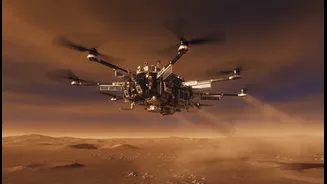
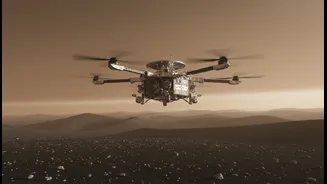
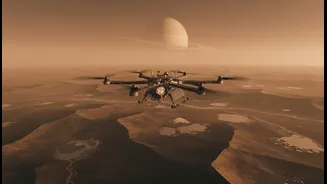
Dragonfly is a revolutionary robotic rotorcraft, about the size of a small car, designed to explore Saturn's largest moon, Titan. Unlike a stationary lander or a wheeled rover, Dragonfly has eight rotors that will allow it to fly from one location to another,
covering vast distances. It will be the first vehicle to perform powered, controlled flight on any moon in our solar system. This mobility is key to its mission: to act as a relocatable science laboratory, hopping across Titan’s diverse landscapes to analyze its surface and atmosphere. Powered by a Multi-Mission Radioisotope Thermoelectric Generator (MMRTG), the same type of nuclear battery used on the Mars Curiosity rover, Dragonfly will have the energy to operate for years in Titan's frigid environment.
Why Send a Drone to Titan?
Titan is one of the most intriguing worlds in our solar system. It’s the only moon with a dense atmosphere, which is mostly nitrogen like Earth's. But beneath its thick, organic haze, Titan has a landscape of liquid methane rivers, lakes, and seas. Scientists believe Titan's environment, rich in complex carbon-based molecules, might be similar to early Earth before life emerged. This makes it a unique natural laboratory for studying prebiotic chemistry—the chemical steps that could lead to life. The Cassini-Huygens mission, which arrived at Saturn in 2004, revealed that Titan also has a subsurface ocean of liquid water, making it a prime target in the search for habitable environments.
A Major Mission Milestone
In early July 2026, the Dragonfly mission achieved a significant milestone. Engineers at the Johns Hopkins Applied Physics Laboratory (APL) completed a series of crucial structural tests. They subjected a full-scale model of the rotorcraft to intense vibrations, simulating the stresses of a rocket launch and the challenging landing on Titan. The tests also confirmed the fuselage is properly sealed, which is critical for protecting the lander’s internal electronics from Titan’s extreme cold, where temperatures average around minus 179 degrees Celsius. These successful tests retire significant risk for the project and clear the way for the team to begin installing the actual flight hardware, including avionics and scientific instruments.
The Challenge of Alien Flight
Flying on Titan presents a unique set of challenges and advantages. The moon's atmosphere is four times denser than Earth's, but its gravity is only about one-seventh as strong. This combination means that flight is much easier to achieve and sustain than on Earth or Mars. However, the extreme cold and the two-hour-long descent through the thick atmosphere pose immense engineering hurdles. Early simulations even revealed a surprise risk: the nuclear power source could cause parts of the lander to overheat on the surface, requiring careful thermal design. By testing the hardware in specialized wind tunnels that replicate Titan's dense, frigid conditions, engineers have demonstrated that Dragonfly can fly and land safely. These leapfrog-style flights will allow the craft to travel over 175 kilometers during its mission, exploring dozens of sites.
The Journey Ahead
With these critical tests complete, the Dragonfly team will continue integrating and testing the spacecraft's components through 2026 and 2027. The mission is currently targeting a launch window in July 2028 aboard a SpaceX Falcon Heavy rocket. The journey to Saturn is a long one; Dragonfly is expected to arrive at Titan in 2034. Once there, it will embark on a science mission of nearly three years, exploring from the equatorial Shangri-La dune fields to the Selk impact crater, where scientists believe liquid water may have mixed with organic materials in the past. Each site will bring new data, helping us understand the potential for life beyond Earth.