



An Ambitious New Chapter
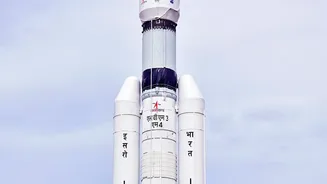
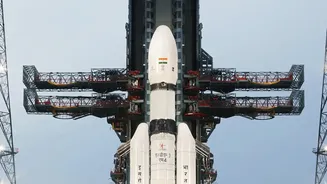
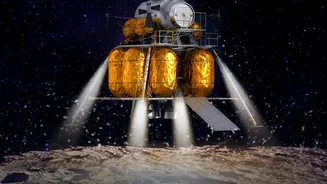
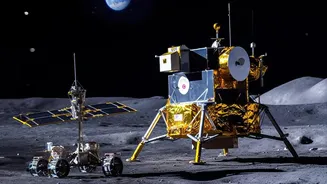
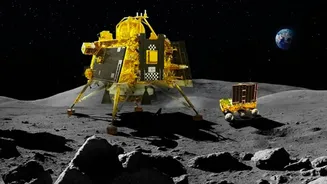
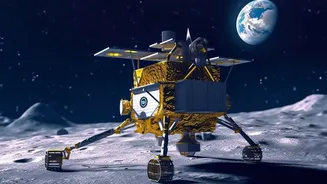
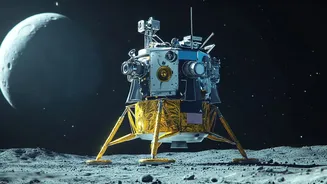
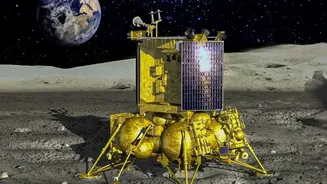
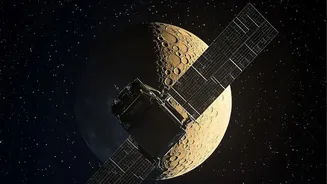
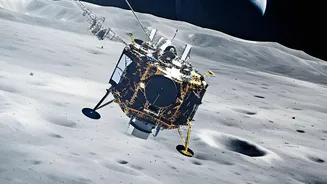
Chandrayaan-4 represents a significant escalation in India's lunar exploration programme. While Chandrayaan-3 proved India's capability to safely land on the Moon, this new mission aims to perform a complex series of manoeuvres: land, collect soil and rock
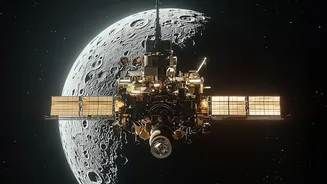
samples, and then launch from the lunar surface to return them to Earth. This feat, known as a sample-return mission, is incredibly challenging and has only been accomplished by a handful of nations. The mission, approved by the Union Cabinet in September 2024, is a cornerstone of India's broader space vision, which includes putting an Indian on the Moon by 2040. Chandrayaan-4 will involve multiple modules and launches, demonstrating advanced capabilities like robotic sampling, ascent from the Moon, and orbital docking.
The Lure of the Lunar South Pole
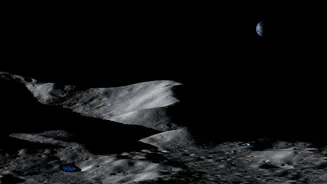
The mission's target, the Moon's south pole, is one of the most compelling destinations in our solar system. Unlike the regions visited by the Apollo missions, the south pole is a land of extreme contrasts. It features areas of near-perpetual sunlight, ideal for solar-powered missions, alongside Permanently Shadowed Regions (PSRs). These PSRs are craters and depressions so deep that sunlight has not reached their floors in billions of years. This creates incredibly cold environments, among the coldest in the solar system, where water ice can remain frozen and stable over geological timescales. India's Chandrayaan-1 mission was instrumental in the initial discovery of water on the Moon, making this return to the pole a logical and exciting next step. Global scientific interest is converging on this region precisely because of its potential to hold these preserved volatile resources.
A Frozen Time Capsule
For scientists, the ice trapped in these shadowed craters is more than just frozen water; it's a cosmic time capsule. This ice is believed to be a record of the ancient solar system. It could contain clues about the origin of water on Earth, the delivery of materials by comets and asteroids, and the history of lunar volcanism. By analysing these samples in advanced labs on Earth, scientists can study their isotopic composition—like the ratio of different types of hydrogen—to trace their origins. The samples are a 'gift that keeps on giving,' allowing for new discoveries years later as analytical technology improves. Retrieving these pristine samples could help answer fundamental questions about how our solar system, and life itself, came to be.
Fueling the Future of Exploration
Beyond its historical significance, lunar ice is also a critical resource for the future of space exploration, a concept known as In-Situ Resource Utilisation (ISRU). Water is essential for sustaining human life, but it's incredibly heavy and expensive to launch from Earth. If the ice at the south pole is abundant enough, it could be harvested and used as drinking water for astronauts and to cool equipment at a future lunar base. More importantly, water (H₂O) can be broken down into its constituent elements: hydrogen and oxygen. Oxygen can be used for breathable air, while both can be used as the primary components of rocket propellant. A lunar base capable of producing its own water, air, and fuel would revolutionise space travel, turning the Moon into a true stepping stone for missions to Mars and beyond. Chandrayaan-4 is a vital step in assessing the real-world feasibility of this vision.
A Masterclass in Robotic Engineering
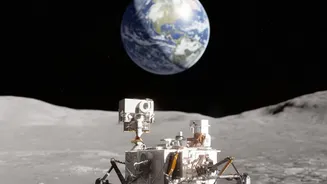
Successfully retrieving a sample from the rugged and treacherous terrain of the lunar south pole is a monumental engineering challenge. The area's long, harsh shadows can confuse landing systems, and the topography is complex and mountainous. The Chandrayaan-4 mission will require a sequence of perfectly executed robotic operations: a precise soft landing, the deployment of a robotic arm to scoop and drill for samples, secure containerisation of the materials, and then the launch of an ascent module from the Moon's surface. This ascender must then rendezvous and dock with a transfer module waiting in lunar orbit, which will carry the samples back for a high-speed reentry into Earth's atmosphere. Mastering these technologies is not just for this one mission; it lays the essential groundwork for India's future human spaceflight ambitions, including landing a 'Gaganyatri' on the Moon.